MAPPING THE FRONTIERS OF ARTIFICIAL INTELLIGENCE AND
HUMAN CREATIVITY NEXUS IN THE DIGITAL AGE
Dr
Bharti Joshi, Professor, Department of Lifelong Learning, DAVV Indore
Ms
Tanuja Khan, Assistant Professor, The Bhopal School of Social Sciences
ABSTRACT
The present chapter examines the
innovative capabilities of Artificial intelligence (AI) systems in contrast to
human writing creativity. With the fast improvements in AI generation, there's
an ongoing debate regarding whether or not AI can shape or maybe surpass human
creativity in numerous domain names, consisting of writing. This look explores
the present-day country of AI-generated writing and its capability impact on
human creativity, highlighting the strengths and limitations of both AI and
human writers. Through a comparative evaluation of AI-generated texts and
human-authored works, we propose to shed light on the precise traits,
innovative strategies, and implications of AI in the realm of writing
creativity.
Keywords: Artificial
Intelligence (AI), Human Writing Creativity
I. INTRODUCTION
The
dawning of the digital age has thrust society into an era where the
intersection of artificial intelligence (AI) and human creativity stands as a
pivotal arena for exploration and innovation. In this rapidly evolving
landscape, the amalgamation of machine intelligence and human ingenuity is
reshaping the dynamics of creative pursuits across diverse domains. This
research embarks on a comprehensive exploration of the AI-human creativity
nexus, aiming to map the frontiers where these two realms converge and
interact. By doing so, the chapter seeks to illuminate the implications,
challenges, and potential breakthroughs inherent in this transformative
juncture, contributing to a nuanced understanding of the evolving relationship
between AI and human creativity.
The
creation of Artificial Intelligence (AI) has revolutionized numerous
industries, which include the world of innovative endeavo
Theoretical
Framework
Creativity
is a multifaceted and complex process that involves the generation of new and
valuable ideas, products, or solutions
Elements
of writing creativity include various elements such as originality,
imagination, exposition, and novelty. Creating content that is new, innovative,
and distinct from existing businesses. This includes thinking beyond
traditional boundaries, challenging established norms, and offering a unique
perspective. Ability to design and create imaginative worlds, characters, and
narratives
Creative
Writing Process
The
creative writing process is a dynamic and iterative journey that includes
inspiration, idea generation, planning and organizing, drafting, editing and
editing, and revising The original spark that starts the creative process
Artificial
Intelligence and Writing Creativity
Artificial
intelligence has greatly enhanced a variety of creative industries, including
writing. AI systems are designed to process and analyze large amounts of data,
recognize patterns, and provide feedback like works written by humans
Artificial
intelligence, characterized by sophisticated machine learning algorithms and
computational prowess, has transcended its conventional role as a tool for
automation and problem-solving. In the contemporary digital milieu, AI has
emerged as a creative force in its own right, capable of generating art,
composing music, and crafting narratives. Concurrently, human creativity
remains an unparalleled force, fueled by intuition, emotion, and the ability to
navigate complex and ambiguous situations. The fusion of these forces holds the
promise of redefining the boundaries of achievement in various fields, from
challenging traditional notions of artistic expression to blending the
mathematical precision of algorithms with the emotional depth of human
experience in music composition.
Significance
of the Chapter
Understanding
the impact of AI on writing creativity is of paramount significance in a
generation in which AI is increasingly applied in content material advent and
era tasks
This
chapter pursuits to contribute to the continuing communication surrounding AI's
impact on writing creativity by carrying out a thorough comparative evaluation
of AI-generated writing and human-authored works
Research
Question
· What are the limitations and challenges of
AI-generated writing compared to human writing creativity?
· How would you define or describe human writing
creativity?
· What aspects of human writing do you believe
set it apart from AI-generated writing?
· What are the unique strengths of human writing
creativity that cannot be replicated by AI?
· How would you compare the creative potential
of AI-generated writing and human writing?
· What are the key factors that contribute to
the quality and originality of human-authored works?
· Does AI have the potential to match or surpass
human writing creativity in the future?
Thematic
Analysis:
RQ1:
How would you define or describe human writing creativity?
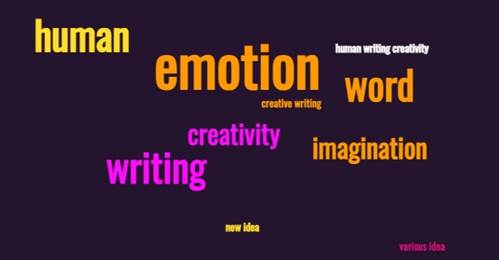
Fig 1. Thematic Analysis to define
human writing creativity
Interpretation:
Human literary creativity is characterized by the intellectual and practical
expression of ideas and experiences through written language to evoke emotion,
convey a unique message, and transcend conventional ideas and paradigms. Human
writers can generate ideas, solve problems, and write knowledge to solve
real-world issues. The raw honesty of human emotions and the meaning of human
experiences make the writing that humans produce valuable and relatable. While
AI has the potential to improve and develop language abilities, it currently
lacks deep emotional understanding and the ability to create truly original and
meaningful information AI may be able to create information based on patterns
and data old-fashioned, yet unable to fully replicate the creative essence and
emotional depths that humans have written and have the potential to evolve and
improve over time. While human writing creativity is currently considered
superior due to emotional relevance and originality, it is possible that in the
future AI could have the potential to produce content that more closely
resembles human creativity
RQ2:
What aspects of human writing do you believe set it apart from AI-generated
writing?
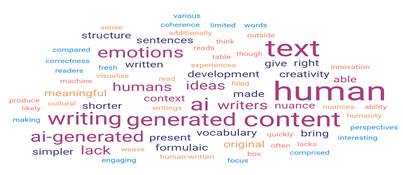
Fig 2. Aspects of human writing
behavior
Interpretation:
Human writing is characterized by using its capability to convey and evoke
feelings. Through written language, human writers can efficiently speak their
studies, cultural nuances, and a feel of humanity. They can weave emotions into
their content material, making it relatable and attractive for readers. On the
other hand, AI-generated textual content regularly lacks the nuanced know-how
of feelings and context that human-written text possesses. AI-generated text
may also have a more formulaic structure, with shorter sentences and easier
vocabulary, that can make it seem system-like. While AI-generated content
material may be green in producing textual content quickly, it regularly lacks
the creativity, innovation, and sparkling views that human writers carry. Human
writers can think outside the container, offer numerous thoughts, and offer
insights, making their writing extra fascinating and thrilling. AI-generated
content may be restricted in its depth and originality in comparison to
human-generated writing. It is crucial to note that AI is created and advanced
by way of human beings. AI structures rely on networks and algorithms created
by humans to acquire and analyze data. While AI can offer reliable and accurate
statistics primarily based on popular or quite rated assets, it can now not own
the equal level of subjectivity, interpretation, and important thinking as
human writers. Human writing famous developments inclusive of originality,
creativity, emotional depth, empathy, subjectivity, interpretation, contextual
knowledge, adaptability, vital questioning, and intuition. These qualities
contribute to the richness and meaningfulness of human-generated content. While
AI has the potential to conform and improve in the future, for now, human
writing stays unheard of in its capacity to create unique, significant, and
emotionally resonant content material.
RQ3:
What are the limitations and challenges of AI-generated writing compared to
human writing creativity?
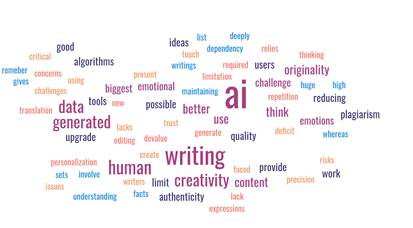
Fig 3. Limitations and Challenges of
AI generated writing
Interpretation:
AI-generated writing regularly lacks precision and emotional intensity. It
struggles to convey a proper emotional touch and might come upon as lacking
authenticity. Trust is a vast challenge faced through AI, as users can be
skeptical approximately the accuracy and reliability of the generated content.
AI has boundaries in its thinking capacity, working inside predefined limits
and algorithms. Using AI writing equipment can gift demanding situations and
dangers for writers. This gear may additionally reduce the authenticity and
originality of writing, potentially leading to plagiarism problems. The
reliance on statistics and algorithms can devalue content and restriction creativity
and vital wondering. AI-generated content may additionally lack personalization
and struggle to generate new ideas. The first class of AI-generated content is
depending on the niceness of the data sets it is educated on. Maintaining
creativity and originality stays a huge undertaking for AI. Human writing,
alternatively, includes feelings, ideas, and a deeper knowledge of human
reviews, making it extra significant and unique. While AI can offer data and
statistics based totally on its programmed knowledge, it lacks emotional
expertise and the identical level of creativity as human writers. Human writing
creativity is typically taken into consideration advanced due to its emotional
depth and potential to generate meaningful and authentic content material.
However, considering the speedy increase and development of AI, it's far viable
that AI-generated writing may also improve over the years. AI can research and
improve itself based totally on user feedback and practices. While AI-generated
writing has its advantages, human-generated writing is currently perceived as
higher, however, the destiny capacity of AI cannot be disregarded.
RQ4: What are the unique
strengths of human writing creativity that cannot be replicated by AI?
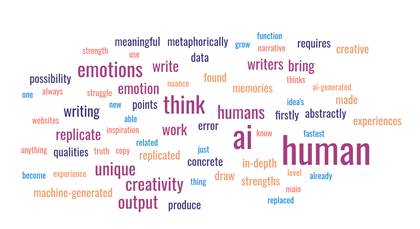
Fig 4. Unique strengths of human
writing creativity
Interpretation:
Emotions play a critical role in human writing creativity. Human writers can
infuse their paintings with emotions and draw on their reviews to create
greater profound and nuanced content. This emotional depth is a unique energy
that AI-generated replica regularly struggles to duplicate as per the data
collected. Unlike AI, human writers can suppose abstractly and metaphorically,
allowing them to move beyond concrete records factors and produce a more
innovative and creative touch to their writing. They can draw suggestions from
diverse assets and include their private studies, memories, and emotions to add
intensity and richness to their paintings. While AI may also excel at supplying
authentic records and preventing human errors, it cannot outlet into the emotional
realm and conveys content that certainly resonates with readers. Human writing
contains a sure authenticity and personal contact that connects with readers on
a deeper level. Additionally, human writing creativity involves the technology
of unique thoughts. Human writers can suppose outdoors the container, explore
new concepts, and offer clear views. AI, on the other hand, is predicated on
present statistics and algorithms, limiting its ability to generate without a
doubt novel ideas. While AI may additionally maintain to strengthen and
broaden, the unique strengths of human writing creativity, specifically the
infusion of feelings, stay a distinguishing thing. Emotions upload a layer of
relatability and depth that AI-generated content material currently struggles
to acquire.
Comparative
Analysis: AI vs. Human Writing Creativity
To
gain insights into the creative capabilities of AI systems in comparison to
human writing creativity, a comparative analysis can be conducted across
various dimensions. The following areas can be explored:
Quality
and Originality of Content:
RQ5:
In your opinion, what are the key factors that contribute to the quality and
originality of human-authored works?
|
·
Life experiences, ability to feel,
and emotions |
|
·
Human-authored works include ideas
and experiences related to the real world. I feel it is more connectable. And
when compared to AI, we can surely trust human ideas than AI-generated facts.
|
|
·
Natural environment |
|
·
Author contributions. Use this form
to specify the contribution of each author of your manuscript. A distinction
is made between five types of contributions: Conceived and designed the
analysis; Collected the data; Contributed data or analysis tools; Performed
the analysis; Wrote the paper. |
|
·
Conceived and designed the
analysis; Collected the data; Contributed data or analysis tools; Performed
the analysis; Wrote the paper |
|
·
Builds quality into the product |
|
·
Human-authored work is connected to
experiences whereas ai generated work is full of facts. |
|
·
human work includes human knowledge
related to real life whereas AI work involves just machine-generated facts |
|
·
The simple language without a huge
words and simple understanding between the author and the reader shows the
originality of human-authored works |
|
·
Humans are eligible to write
through emotions and originally |
|
·
Imagination and Creativity,
Personal Experiences and Perspectives, Emotional Depth and Empathy, Skills
and Adaptability Contextual Understanding Critical Thinking, and Original
Research |
Conclusion:
Human-authored works maintain a special vicinity because of their connection
with actual-life reports, feelings, and the personalized touch they provide.
They incorporate elements of the herbal environment and possess qualities along
with originality, empathy, and important wondering. These elements distinguish
human-authored works from AI-generated content, which focuses more on actual
statistics derived from facts analysis.
Emotional
and Expressive Elements:
RQ6:
Based on your understanding and experience, how would you compare the creative
potential of AI-generated writing and human writing?
|
·
If one gives right prompts to AI it
will be able to generate good reports |
|
·
It is better than human writing but
it cannot beat it because it lacks experiences and emotions |
|
·
I believe working with AI is
effective but at the same time, we can't trust AI fully because, in the end,
it is a technologically generated tool to make life easy. |
|
·
AI's creative potential is in limit
and humans are limited less |
|
·
While AI-generated content may be
able to produce content quickly, it often lacks the creativity and innovation
that human writers can bring to the table. Human writers can think outside
the box and bring fresh perspectives to your content, making it more engaging
and interesting for your readers. |
|
·
Can artificial intelligence be more
creative than humans in content writing skills? |
|
·
AI-generated content might be able
to produce content quickly, it lacks the creativity and storytelling ability
of human writers. Human writers can craft narratives that connect with
readers on an emotional level, drawing them in and keeping them hooked until
the very end. |
|
·
It can be difficult to find a
reliable that understands your needs. |
|
·
AI-generated writing might take
less time compared to human writing but we cannot fully trust it cause again
it is a human-generated tool. |
|
·
working with AI is more effective
and fast but it is not trustworthy |
|
·
We can accept that human writing
can generally have mistakes as well as a generated usually not occur mistake
it saves time where human writing takes much time |
|
·
By looking at the growth of AI it
can be possible in the future that AI can do better |
|
·
AI-generated writing has made
significant progress and can produce coherent and readable content, it
currently falls short in terms of the depth, originality, emotional
resonance, and subjective interpretation that human writing offers. The
creative potential of human writing remains unparalleled due to the rich
complexity of human consciousness, imagination, and experiences. |
|
·
By comparing the creative potential
of AI-generated writing and human writing, humans can do better but in the
future by looking at the increasing growth of AI, AI can do better |
Conclusion:
AI can generate proper reviews when given suitable activities. Although AI is
higher than human writing in some elements, it cannot surpass human writing
because it lacks stories and feelings. While working with AI is effective,
entire trust in AI isn't possible as it's far in the long run a device created
to simplify existence. The creative capacity of AI is constrained, at the same
time as people have countless capabilities in this regard. Although AI-generated
content may be produced speedy, it frequently lacks the creativity and
innovation that human writers convey. Human writers can assume outdoor the
field, offer sparkling perspectives and make content extra attractive and
interesting. AI-generated content may also lack the storytelling potential and
emotional connection that human writers possess. Finding a reliable AI that
understands unique needs may be difficult. Although AI-generated writing may be
faster, it can't be completely trusted considering it is in the long run a
human-created tool. Working with AI is extra efficient and quicker, however, it
could now not be completely sincere. While human writing can contain errors,
AI-generated writing is generally blunders-loose, saving time. Considering the
increase in AI, it is possible that AI can also perform higher in the future.
Currently, AI-generated writing has made huge progress in producing coherent
and readable content. However, it falls short in phrases of intensity,
originality, emotional resonance, and subjective interpretation as compared to
human writing. The innovative ability of human writing remains exceptional
because of the complexity of human consciousness, imagination, and stories.
While humans presently outperform AI in phrases of innovative potential, the
destiny growth of AI suggests that it can sooner or later capture up or maybe
surpass human competencies.
Adaptability
and Innovation:
RQ6:
Do you believe AI has the potential to match or surpass human writing
creativity in the future? Why or why not?
|
·
I think it can match human writing.
it is getting better each day and may surpass human intelligence and writing.
|
|
·
It can surpass if it develops
emotions like humans |
|
·
What I believe is that AI has the
power to go beyond human writing. The growth of technology in every single
factor is reaching its peak. So AI not only has the power to match with
humans, It can go beyond what humans think. |
|
·
No, because we know that AI is made
by human |
|
·
However, it's important to remember
that AI is still a tool, and it's unlikely to ever fully replace the
creativity and insight that humans bring to the writing process. While AI may
one day play a larger role in writing articles, it's unlikely to completely
take over the job of human writers. |
|
·
it's unlikely to ever fully replace
the creativity |
|
·
However, it's important to remember
that AI is still a tool, and it's unlikely to ever fully replace the
creativity and insight that humans bring to the writing process. While AI may
one day play a larger role in writing articles, it's unlikely to completely
take over the job of human writers. |
|
·
No, it is unlikely to ever fully
replace the creativity |
|
·
Yes, cause AI is increasing day by
day so it surely surpasses human writing |
|
·
yes I do believe AI is more
powerful than human |
|
·
Yes it can be as robotics can have
a capability of it in the future ai can surpass human writing capability
Albert Einstein says that if ai surpass human writing capability all of the
work that is done by human is done by ai till it is controlled by humans and
if not so as Albert's intestine say it is the biggest curse for a human |
|
·
Maybe, yes by looking at the growth
of AI it can be possible |
|
·
Maybe but I am not sure because
Given the increasing growth of AI may gain the potential like human writing
creativity in the future |
|
·
Maybe, I think AI has the potential
to match or surpass human writing creativity in the future |
Conclusion:
As per the responses above there are varying ideas about whether AI can surpass
human writing. Some agree that AI is continuously improving and has the
potential to surpass human intelligence and writing talents. The development of
feelings in AI is seen as a possible pathway for surpassing human writing. The
growth of technology and AI's potential to move past human questioning are
considered factors that can contribute to its capacity to match or exceed human
writing. On the alternative hand, some argue that AI, being created through
humans, cannot fully update the creativity and perception that human beings
deliver to writing. It is acknowledged from the data that AI is a device and is
not likely to update human creativity in the writing method. While AI may also
play a larger function in writing, it's far not going to completely take over
from human writers. The growing competencies of AI lead some to agree with that
it could surpass human writing, even as others are unsure or skeptical. The
ability of AI to surpass human writing is considered both possible and
uncertain, with some thinking about it as an extensive development and others
expressing warning approximately the consequences.
Implications
and Future Directions
The
integration of AI in the writing landscape has implications for professional writers
and authors. AI-generated writing tools can automate certain tasks, such as
proofreading and content generation, potentially increasing efficiency and
productivity
The
integration of AI inside the writing landscape has implications for expert
writers and authors. AI-generated writing tools can automate certain
responsibilities, including proofreading and content generation, doubtlessly
increasing performance and productivity
Conclusion
The
evaluation between AI-generated writing and human writing creativity highlights
the strengths and obstacles of every technique. While AI structures excel in
producing coherent and contextually applicable content material, they warfare
to capture the intensity of emotional expression, originality, and artistic judgment
exhibited through human writers
REFERENCES
[1] Anantrasirichai, N., &
Bull, D. (2022). Artificial intelligence in the creative industries: a review. Artificial
Intelligence Review, 55(1). https://doi.org/10.1007/s10462-021-10039-7
[2] Casazza, M.,
& Gioppo, L. (2020). A playwriting technique to engage in a shared
reflective enquiry about the social sustainability of robotization and
artificial intelligence. Journal of Cleaner Production, 248. https://doi.org/10.1016/j.jclepro.2019.119201
[3] Cooper, G.
(2023). Examining Science Education in ChatGPT: An Exploratory Chapter of Generative
Artificial Intelligence. Journal of Science Education and Technology. https://doi.org/10.1007/s10956-023-10039-y
[4] Ghajargar,
M., Bardzell, J., & Lagerkvist, L. (2022). A Redhead Walks into a Bar:
Experiences of Writing Fiction with Artificial Intelligence. ACM
International Conference Proceeding Series. https://doi.org/10.1145/3569219.3569418
[5] Gobet, F.,
& Sala, G. (2019). How artificial intelligence can help us understand human
creativity. Frontiers in Psychology, 10(JUN). https://doi.org/10.3389/fpsyg.2019.01401
[6] Hitsuwari,
J., Ueda, Y., Yun, W., & Nomura, M. (2023). Does human–AI collaboration
lead to more creative art? Aesthetic evaluation of human-made and AI-generated
haiku poetry. Computers in Human Behavior, 139. https://doi.org/10.1016/j.chb.2022.107502
[7] How to
optimize marketing strategy development: A potent blend of human and artificial
intelligence. (2020). In Strategic Direction (Vol. 36, Issue 8). https://doi.org/10.1108/SD-05-2020-0106
[8] Kantosalo,
A., & Riihiaho, S. (2019). Quantifying co-creative writing experiences. Digital
Creativity, 30(1). https://doi.org/10.1080/14626268.2019.1575243
[9] Karimi, P.,
Rezwana, J., Siddiqui, S., Maher, M. Lou, & Dehbozorgi, N. (2020). Creative
sketching partner: An analysis of human-AI co-creativity. International
Conference on Intelligent User Interfaces, Proceedings IUI. https://doi.org/10.1145/3377325.3377522
[10] Leach, N.
(2022). AI and the limits of human creativity in urban planning and design. In Artificial
Intelligence in Urban Planning and Design: Technologies, Implementation, and
Impacts. https://doi.org/10.1016/B978-0-12-823941-4.00013-5
[11] Lee, H. K.
(2022). Rethinking creativity: creative industries, AI and everyday creativity.
Media, Culture and Society, 44(3). https://doi.org/10.1177/01634437221077009
[12] Main, A.,
Grierson, M., Yamada-Rice, D., & Murr, J. (2022). Augmenting Personal
Creativity with Artificial Intelligence Workshop proposal for Creativity and
Cognition 2022. ACM International Conference Proceeding Series. https://doi.org/10.1145/3527927.3531205
[13] Mammen, C.
E., & Richey, C. (2020). AI and IP: Are Creativity and Inventorship
Inherently Human Activities? FIU Law Review, 14(2). https://doi.org/10.25148/lawrev.14.2.9
[14] Mazzone, M.,
& Elgammal, A. (2019). Art, Creativity, and the Potential of Artificial
Intelligence. Arts, 8(1). https://doi.org/10.3390/arts8010026
[15] Micchi, G.,
Bigo, L., Giraud, M., Groult, R., & Levé, F. (2021). I Keep Counting: An
Experiment in Human/AI Co-creative Songwriting. Transactions of the
International Society for Music Information Retrieval, 4(1). https://doi.org/10.5334/tismir.93
[16] Miroshnichenko,
A. (2018). AI to bypass creativity. Will robots replace journalists? (The
answer is “yes”). In Information (Switzerland) (Vol. 9, Issue 7). https://doi.org/10.3390/info9070183
[17] Rezwana, J.,
& Maher, M. Lou. (2022a). Designing Creative AI Partners with COFI: A
Framework for Modeling Interaction in Human-AI Co-Creative Systems. ACM
Transactions on Computer-Human Interaction. https://doi.org/10.1145/3519026
[18] Rezwana, J.,
& Maher, M. Lou. (2022b). Understanding User Perceptions, Collaborative
Experience and User Engagement in Different Human-AI Interaction Designs for
Co-Creative Systems. ACM International Conference Proceeding Series. https://doi.org/10.1145/3527927.3532789
[19] Rohrmeier,
M. (2022). On Creativity, Music’s AI Completeness, and Four Challenges for
Artificial Musical Creativity. In Transactions of the International Society
for Music Information Retrieval (Vol. 5, Issue 1). https://doi.org/10.5334/tismir.104
[20] Salami, N.
S. (2019). Human Creativity and Artificial Intelligence (AI): Two Distinct
Requirements for Sustainable Competitive Advantage. Westcliff International
Journal of Applied Research, 2(2). https://doi.org/10.47670/wuwijar201822nss
[21] Sundararajan,
L. (2014). Mind, machine, and creativity: An artist’s perspective. Journal
of Creative Behavior, 48(2). https://doi.org/10.1002/jocb.44
[22] Wingström,
R., Hautala, J., & Lundman, R. (2022). Redefining Creativity in the Era of
AI? Perspectives of Computer Scientists and New Media Artists. Creativity
Research Journal. https://doi.org/10.1080/10400419.2022.2107850
[23] Wu, Z., Ji,
D., Yu, K., Zeng, X., Wu, D., & Shidujaman, M. (2021). AI Creativity and
the Human-AI Co-creation Model. Lecture Notes in Computer Science (Including
Subseries Lecture Notes in Artificial Intelligence and Lecture Notes in
Bioinformatics), 12762 LNCS. https://doi.org/10.1007/978-3-030-78462-1_13
[24] Xu, S.,
& Wang, Z. (2021). Diffusion: Emotional visualization based on biofeedback
control by eeg: Feeling, listening, and touching the real things through human
brainwave activity. Artnodes, 2021(28). https://doi.org/10.7238/a.v0i28.385717
[25] Yu, E.
(2023). INTELLIGENT ENOUGH? ARTIFICIAL INTELLIGENCE FOR ONLINE LEARNERS. Journal
of Educators Online, 20(1). https://doi.org/10.9743/JEO.2023.20.1.16