A STUDY OF TEACHERS’ PROFESSIONAL DEVELOPMENT TO PROMOTE THE MENTAL
WELL-BEING OF STUDENTS
Harshita Panjani
Research Scholar, Amity Institute of Education, AUUP, Noida
harshita.panjani@s.amity.edu
Prof. Sheena Thomas
The Bhopal School of Social Sciences Bhopal, Madhya Pradesh
Prof. Alka
Mudgal
Head of Institute, Amity Institute of Education, AUUP, Noida
ABSTRACT
Mental
well-being is essential for the personal growth and academic success of
students. Teachers are observing
students with conduct problems that have their source in emotional distress,
peer pressure, school pressures, and home problems. These behavioural
difficulties—aggression and withdrawal, to anxiety and defiance—tend to
interfere with learning and interpersonal relationships, particularly if not
dealt with. Promoting the well-being of students within the educational
framework is essential for building emotionally balanced, socially compliant,
and academically successful students. NEP 2020 has also emphasized the holistic
development of students, including their emotional and mental health. Youth
Self-Report (YSR) form, a part of the Achenbach System of Empirically Based
Assessment (ASEBA) developed by Achenbach and Rescorla (2001), was used to
collect data. The research examines the behavioural issues among secondary
stage students in government and private schools, highlighting the
psychological disparities and the implications for the educators. The study
finds significant differences in behavioural problems between the two groups.
The research also examines gender-based disparities in teen behaviour, whereby
male students are revealed to have more behavioural issues than females. The
results highlight the need for teacher professional development to empower
educators with skills to identify and manage behavioural challenges to ensure a
supportive and mentally healthy school environment.
Keywords: Mental well-being, Behavioural problems, Professional
Development, NEP 2020
INTRODUCTION
The
rising incidence of mental health problems among students is a major area of
concern for academics, school officials, and policymakers (WHO, 2021; Malhotra,
Kohli, & Kapoor, 2009; Mo, 2024). Academic pressure, exposure to social
media, family crisis, peer strife, and continued post-pandemic stress have been
recognized as key causal factors behind the declining mental health of youths
(Auerbach et al., 2018; Verywell Mind, 2023; Barreto-Rivas et al., 2023). The
stressors usually take the form of classroom behavioral problems, such as
defiance, withdrawal, aggression, and attention problems, which not only impact
students' academic achievements but also interfere with the general classroom
environment (Malhotra et al., 2009).
Teachers
are the immediate interactors to students, and can easily detect early warning
signs of psychological distress (Pozo-Rico et al., 2023). The Central Board of
Secondary Education (CBSE) has released a number of directives highlighting the
important role teachers can play in detecting and dealing with students'
psychological distress. Since teachers are in contact with students on a daily
basis, CBSE recognizes their special position to observe indications of mental
illness early on. However, most teachers also say they feel under-supported and
under-prepared in dealing with students' mental health issues (Verywell Mind,
2023; WHO, 2021). Hence, developing the capacities of teachers through ongoing
professional development is necessary to promote supportive, inclusive, and
psychologically safe learning environments (NEP, 2020), as highlighted by CBSE
also through its emphasis on life skills and wellness programs (CBSE, 2024).
Research also lends credence to this necessity, reflecting increased teachers'
self-efficacy and psychological well-being through systematic training (Barreto-Rivas
et al., 2023) and the necessity of emotional intelligence
and resilience in schools (Pozo-Rico et al., 2023).
NEP
2020 recognizes the overall development of students’ emotional and mental
health, along with cognitive skills, as essential for quality education. It
considers socio-emotional learning (SEL), psychological well-being, and
emotional growth as a part of the Holistic development approach. (NEP
2020, Para 4.4 & 4.25). Schools are envisioned
as a secure, safe environment where emotional and psychological requirements
are catered to. NEP 2020 emphasizes a health and well-being curriculum with
stress management, mental health awareness, and emotional well-being. Such a
curriculum should incorporate elements that enhance empathy, resilience,
communication, and emotional intelligence. Co-curricular activities like yoga,
meditation, and sports are to be promoted for emotional and physical well-being
of students. (NEP 2020, Para 12.5).
The
policy emphasizes the significance of identifying and treating behavioral
problems using preventive and reactive measures, including suggestions for
creating school wellness centers for managing behavioural and emotional
concerns of students. It also proposes
implementing customized support
systems, including mentorship programs and mental health clubs. (NEP
2020, Para 4.28, Para 5.16)
LITERATURE REVIEW
Mental
well-being
Mental health is a
student's emotional, psychological, and social functioning, which is
determinative of learning, decision-making, and relationship formation (WHO,
2021; Mo, 2024). Auerbach et al. (2018) estimate that almost one-third of all
adolescents worldwide have a diagnosable mental disorder, but most are not
diagnosed and supported in schools. Additionally, studies from the Maternal and
Child Health Bureau (2023) indicate mental and behavioral health illnesses have
risen sharply among young people after COVID-19, with significant effects on
academic performance and social relationships.
Students with low
mental health are likely to experience absenteeism, poor academic achievement,
and behavioural problems (Malhotra et al., 2009; Mo, 2024). They are also at
greater risk of school dropout or chronic emotional disorders in the adult
years (Auerbach et al., 2018). Thus, schools need to integrate mental wellness
as a key component of their curriculum goals.
Behavioural
Problems
Behavioral
issues among students—like disruptive speaking, distractibility, aggression,
and social withdrawal—are usually an expression of unresolved emotional issues.
Malhotra, Kohli, and Kapoor (2009) stress that such behaviors usually have
their origin in undiagnosed mental illness among teenagers. Current surveys in
classrooms indicate increasing teacher reporting of post-pandemic spikes in
disruptive behavior (EdWeek, 2025). The World Health Organization (2021) has
also noted that adolescent emotional distress tends to manifest as behavioral
symptoms at school.
Research
in the Indian as well as other contexts indicates that behavioral problems are
more common among students attending private schools because of scholastic
competitiveness and parental pressure. Malhotra et al. (2009) also observed
that socio-academic pressures are responsible for behavioral disturbances,
especially in high-performing scholastic environments.
Gender
differences are also significant. The CBSE (2024) reports that male students
tend to show externalizing behaviors like aggression or disrespect, whereas
female students tend to internalize stress and present with symptoms of anxiety
and depression. Mo (2024) also supports this trend, calling for
gender-sensitive behavioral intervention strategies for schools.
Untreated
behavioral issues can escalate into adolescent peer violence, self-esteem
problems, academic deterioration, or even drug abuse during adolescence. The
World Health Organization (2021) cautions that unmanaged emotional disorders in
adolescents are associated with increased risks of substance misuse and
long-term psychological impairment. Auerbach et al. (2018) also state that
early behavioral symptoms tend to be precursors to chronic adult emotional
conditions, and therefore, prompt identification and intervention by classroom
teachers are essential.
OBJECTIVES
· To assess the behavioural problems among Secondary
school students.
· To compare the behavioural problems of secondary school
students of Private and government schools.
· To compare the behavioural problems of male and female
secondary school students.
· To identify the school-based
mental well-being initiatives by the government to support the mental
well-being of students.
· To identify the sources of Teachers’ professional
development for managing classroom behaviour and supporting the mental
well-being of students.
HYPOTHESES
H1:
There is a significant difference in behavioural problems among male and female
secondary school students.
H2:
There is a significant difference in behavioural problems between secondary
school students of government and private schools.
METHODOLOGY
A
comparative descriptive study was conducted with a sample size of 80 secondary
school students, i.e., 40 students of government schools and 40 students of
private schools. Adolescent students of age group 15-18 years have been taken, of
whom 40 students (20 boys and 20 girls) are from Private schools and 40
students (20 boys and 20 girls) are from government schools. Data were gathered
using the Youth Self-Report form (YSR), a component of the Achenbach System of
Empirically Based Assessment (ASEBA) created by Achenbach and Rescorla (2001).
A standardized, validated, and reliable measure, this form is utilized
extensively for assessing behavioral and emotional difficulties in subjects
between the ages of 11 and 18. The scale contains several subscales measuring
internalizing difficulties (e.g., depression, anxiety), externalizing
difficulties (e.g., rule-breaking, aggression), and general behavior
functioning. Respondents are asked to rate items on a 3-point Likert scale from
0 (not true) to 2 (very true or often true).
Statistical
Methods, such as Mean scores and standard deviation were used to analyse data. An
independent samples t-test was utilized to ascertain statistical significance
among the groups' behavioural problems
ANALYSIS
Data were analysed to provide a meaningful picture of
the raw data collected. The analysis is done
considering the objectives and hypothesis.
Table 1
Sample for study
|
Gender |
Adolescent
students (15-18 years) |
Total
(Adolescent students) |
|
|
(Government
school) |
(Private school) |
||
|
Male |
20 |
20 |
40 |
|
Female |
20 |
20 |
40 |
|
Total |
40 |
40 |
80 |
Table 2
Comparison
of Behavioural Problems among Male and Female Adolescents
|
Gender |
N |
Mean |
SD |
t-stat |
|
Male |
40 |
73.85 |
6.179 |
4.401** |
|
Female |
40 |
67.15 |
7.381 |
** Significant at both
0.01 and 0.05 level of confidence
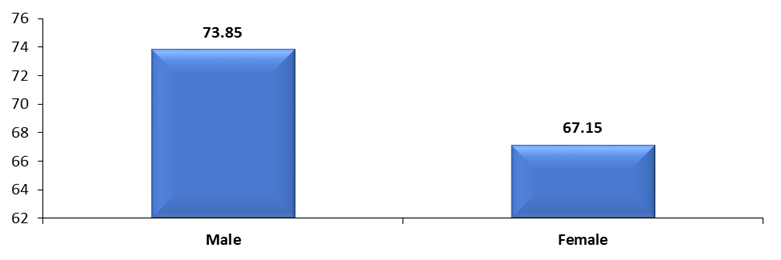
Figure1 Showing
means of behavioural problems among male and female adolescents
An independent
samples t-test was conducted to compare behavioural problem scores between male
and female adolescents. Results shown in table 1 indicated that male students
(M = 73.85, SD = 6.18) reported significantly higher behavioural problem scores
than female students (M = 67.15, SD = 7.38), t(78) = 4.40, p <
.01. This difference was statistically significant at both the 0.01 and 0.05
levels of confidence. Thus, the
Hypothesis (H1), which states that “There is a significant difference in behavioural
problems among male and female secondary school students” is accepted.
Table2
Comparison
of Behavioural Problems among Adolescents from Private and Government Schools
|
School Type |
N |
Mean |
SD |
t-stat |
|
Private |
40 |
72.85 |
5.942 |
2.909** |
|
Government |
40 |
68.15 |
8.309 |
** Significant at both 0.10 and
0.05 levels of confidence
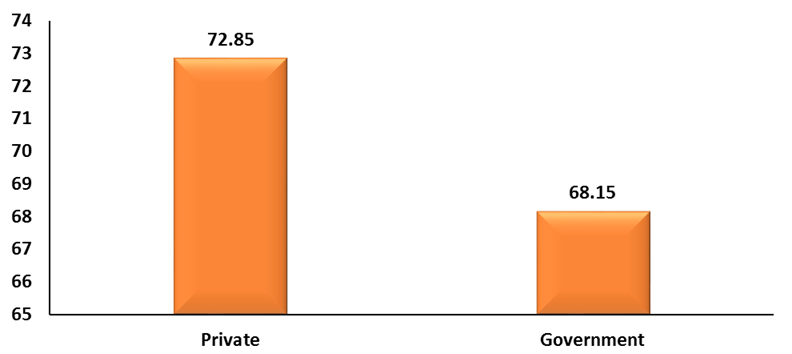
Figure2 Showing means of
behavioural problems among adolescents from government and private schools
An independent
samples t-test was conducted to examine differences in behavioural problems
between private and government school students. Results showed that students
from private schools (M = 72.85, SD = 5.94) had significantly higher
behavioural problem scores than students from government schools (M = 68.15, SD
= 8.31), t(78) = 2.91, p < .01. This difference was
statistically significant at both the 0.01 and 0.05 levels of confidence.The
t-stat value is 2.909 which is significant at both 0.01 and 0.05 levels of
confidence. Thus, the Hypothesis (H2)
which states that “There is a significant difference in behavioural problems
between secondary school students of government and private schools.” is accepted.
RESULTS
AND DISCUSSION
The Youth
Self-Report™ (YSR) (2001) questionnaire was used to identify the nature and
extent of behavioural issues in government and private school adolescents.
Gender-wise comparison has also been made.
Gender-wise
Comparison of Behavioural Problems among Students (Table2)
The mean score for
behavioural problems for male adolescents (N=40), was 73.85 and that for female
adolescents (N=40) was 67.15. t-statistic value was 4.401, which is significant
at both the 0.01 and 0.05 levels of confidence. This indicates that Male
adolescent students exhibit more behavioural problems as compared to Female
adolescent students. This includes more external behaviours like aggression,
rule-breaking, and conduct problems.
School-based
Comparison of Behavioural Problems among Students
The private school
adolescents (N=40) had a mean score of 72.85, whereas the government school
adolescents (N=40) had a mean score of 68.15. The value of the t-statistic was
2.909, which is significant at 0.01 and 0.05 levels. The results indicate that
the Teenagers in private schools have more behaviour problems compared to
government school students. This could be due to increased academic pressure,
parental pressures, or social comparison that is prevalent in private school
settings.
These outcomes
align with findings of previous research by Malhotra, Kohli, and Kapoor (2009),
which indicated that male students reflect more externalizing behaviours such
as aggression, rule-breaking, and defiance. Research by Mo (2024) and a document
by CBSE(2024) confirm the observation that behavioural problems among boys tend
to be more overt, whereas girls tend to internalize emotional distress,
presenting symptoms of anxiety, withdrawal, or depression. Such evidence
highlights the necessity for developing gender-sensitive behavioural
interventions to use in schools, keeping in mind the various expressions of
emotions and behaviour in boys and girls. The results also suggest that the
private school students exhibit more behavioural problems than government
school students. This is consistent with research by Auerbach et al. (2018),
which found that academic pressure, parental pressure, and social comparison
were contributing factors to increased stress and mental health problems in
students. The competitive and performance-oriented environment of the private
schools leads to emotional imbalances and results in behavioural problems.
The National
Education Policy (NEP) 2020 highlights student well-being, socio-emotional
learning, and teacher training as important aspects. A comprehensive model of
education, incorporating emotional well-being and ongoing teacher professional
training. (Para 4.25 & 5.15, NEP 2020). CBSE also underscores the need to
focus on life skills development and mental wellness, with an incentive for
schools to incorporate wellness education and counseling services.(CBSE
Circular No. Acad-24/2024)
Teachers’
Professional Development
As
mental health challenges affect adolescents with high impact, there is a need
for responsive and empathetic school systems (WHO, 2021; Auerbach et al.,
2018). Behavioral problems are not discipline issues but symptoms of underlying
psychological needs, frequently overlooked through the lack of appropriate
training provisions for teachers (Malhotra, Kohli, & Kapoor, 2009; Mo, 2024).
Teachers are best suited to identify and support students, provided they are
properly trained and emotionally ready (Pozo-Rico et al., 2023; Barreto-Rivas
et al., 2023). Systematic professional development programs—via NEP-compliant
platforms such as DIKSHA and SWAYAM, or projects funded by CBSE—can make
teachers wellness ambassadors capable of promoting safe and inclusive
classrooms (NEP, 2020; CBSE, 2024). Only through these systemic, policy-enabled
interventions, the schools foster resilient, emotionally sound learners (NCTE,
2021; CBSE, 2024). Teachers require regular and structured training to
recognize the mental health concerns of students at an early stage and to
provide them with the required support. The teachers who receive training in
the areas associated with mental health, emotional stability, and resilience
show improvements in emotional competence, classroom management, and can
develop empathetic communication strategies to build strong connections with their
students. (Pozo-Rico et al.,2023) Improvements and enhancements in Teachers'
psychological well-being and their professional self-efficacy enable them to
manage behavioural problems more effectively. (Barreto-Rivas et al.,2023)
NEP
2020 recommends a minimum of 50 hours of annual CPD (Continuous Professional
Development) for all teachers including the areas of child psychology, health
and wellness education and inclusive education practices. Schools need to
initiate life skills and wellness programs to address the rising concern of
behavioural issues among students.(CBSE,
Circular No. Acad-24/2024)
The
Central Board of Secondary Education (CBSE) has released several guidelines
highlighting the important role of teachers in recognizing and dealing with
students' psychological distress. With an understanding that teachers work with
students daily, CBSE stresses their special position to notice early warning
signs of mental distress.
In
Circular No. CBSE/M&PR/Counseling/Mapping/2024 dated 26.06.2024, CBSE
mandates that each secondary and senior secondary school make an appointment of
a full-time Counselor & Wellness Teacher. This professional needs to be
trained in psychology, child development, or have a diploma in career guidance
and counseling. The intention is to see that schools are endowed with dedicated
staff members who can cater to the mental and emotional needs of students.
Moreover,
CBSE's Circular No. CBSE/M&PR/Counseling/Conclave-2 of 30.09.2024 declares
a virtual Conclave dedicated to strengthening mental health care in schools.
The activity stresses the integration of teachers, counselors, and families to
make students emotionally resilient. It also underscores the school principals'
leadership in developing caring environments.
CBSE
conducted a series of Capacity Building Programs in several cities to update
the capability of school counselors and wellness teachers. These programs are
aligned with National Education Policy (NEP) 2020, focusing on psychosocial and
career aspirations of students. All these efforts of CBSE towards streamlining
mental health care in the educational process, viewing teachers as central to
facilitating students' mental well-being.
Government
Initiatives
Government
and National Education Organisations prepared technology platforms for the professional
development of teachers that offer courses and training programs for improving
teachers' ability to promote student mental health. These platforms include:
· DIKSHA(Digital Infrastructure for Knowledge Sharing)
is a digital platform launched by the Ministry of Education, Government of
India. It offers various courses, e-content, and Teaching-Learning material for
teachers, students, and administrators.
"Social Media Safety and Well-being" course is also available
on DIKSHA with a focus on digital well-being and mental health consciousness.
· SWAYAM(Study Webs of Active Learning for Young
Aspiring Minds) is a Technology platform by the Ministry of Education,
Government of India. It offers free Massive Open Online Courses (MOOCs) for
teachers, students, and professionals. For promoting mental well-being, it
provides courses such as "Mental Health & Adjustment," aimed at
building knowledge and skills in the area of mental hygiene and psychological
well-being.
· CBSE Training portal, managed by CBSE Centre of
Excellence (CoE), conducts face-to-face and online training for principals and
teachers in various domains. To equip teachers with counselling and management
skills, it organizes frequent workshops and counselling sessions, e.g., the
National Adolescent Summit 2024, on life skills, mental health, safety, and
well-being.
· PRASHAST App is launched by the Ministry of Education
and NCERT under the Samagra Shiksha Abhiyan to promote inclusive education.
This App can help teachers identify behavioural and emotional challenges faced
by the students. This App can support teachers in planning interventions in
collaboration with special educators and counsellors.
RECOMMENDATIONS
· To integrate mental health education with the regular
school curriculum, including sessions on life skills, mindfulness, and stress
management.
· Establishing dedicated wellness centres or counselling
units to provide emotional and psychological support to students as recommended
in NEP 2020.
· Creating a safe and inclusive environment through peer
mentoring and support programmes.
· To ensure the implementation of structured plans for
students' mental well-being and behavioural support.
· Teachers' training on early screening tools like
PRASHAST App for identification of students with emotional and behavioural
concerns.
· Establishment of professional learning communities
(PLCs) for teachers to share their experiences, case studies, and best
practices.
· Promoting Action- Research on behavioural trends and
students' mental health challenges.
CONCLUSION
The
mental well-being of students is an integral part of their academic achievement
and overall growth. Behavioral problems as a result of mental illness can
greatly impact the learning environment. For this reason, it is necessary to
invest in teacher professional development to allow educators to be wellness
ambassadors in their respective schools. Through capacity-building programs and
linkage with national education policies, schools can foster an environment
that focuses on the mental well-being of the students to develop a culture of
empathy, understanding, and holistic development. The research emphasizes the
urgent need for school systems, especially private ones, to incorporate
prevention mental health approaches, to focus on teacher education, and
wellness-based practices. It also reflects the need for differentiated
behavioral support measures in male and female students. Empowering educators to become wellness
ambassadors, as proposed in NEP 2020 and CBSE directives, is not merely a
policy initiative but an operational imperative to enhance behavioural outcomes
and facilitate emotional resilience among teenagers. Strengthening school
wellness programmes, expansion of opportunities for professional development of
teachers with NEP aligned mental health strategies are necessary initiatives to
ensure that schools are not only places of learning but also hubs of
comprehensive student well-being.
REFERENCES
Achenbach,
T. M., & Rescorla, L. A. (2001). Manual for the ASEBA school-age forms
& profiles. Burlington, VT: University of Vermont, Research Center for
Children, Youth, & Families.
Auerbach,
R. P., Mortier, P., Bruffaerts, R., Alonso, J., Benjet, C., Cuijpers, P., ...
& Kessler, R. C. (2018). WHO World Mental Health Surveys International
College Student Project: Prevalence and distribution of mental disorders. Journal
of Abnormal Psychology, 127(7), 623–638. https://doi.org/10.1037/abn0000362
Barreto-Rivas,
M., Rodríguez-Chávez, R., & López-González, L. (2023). Effectiveness of a
training program on the psychological well-being and self-efficacy of active
teachers, controlling for gender and experience. Education Sciences, 15(3),
382. https://doi.org/10.3390/educsci15030382
Bisht,
A. R. (1987). Academic Stress of Adolescents in Government and Private
Schools. Retrieved from https://www.academia.edu/42222103
Central
Board of Secondary Education (CBSE). (2024). Circular No. Acad-24/2024:
Promotion of life skills and mental health in schools.
https://cbseacademic.nic.in/web_material/Circulars/2024/24_Circular_2024.pdf
Central
Board of Secondary Education (CBSE). (2024). Notification on appointment of
Wellness Teachers and School Counsellors
(CBSE/M&PR/Counseling/Mapping/2024).
https://www.cbse.gov.in/cbsenew/documents/ECWS_Notification_26062024.pdf
EdWeek.
(2025, January). Is student behavior getting any better? What a new survey
says. Education Week.
https://www.edweek.org/leadership/is-student-behavior-getting-any-better-what-a-new-survey-says/2025/01
Malhotra,
S., Kohli, A., & Kapoor, M. (2009). Behavioral and emotional problems in
school-going adolescents. Indian Journal of Pediatrics, 76(6), 575–579.
Maternal
and Child Health Bureau. (2023). NSCH Data Brief: Adolescent Mental and
Behavioral Health.
https://mchb.hrsa.gov/sites/default/files/mchb/data-research/nsch-data-brief-adolescent-mental-behavioral-health-2023.pdf
Ministry
of Education. (2020). National Education Policy 2020. Government of
India.
https://www.education.gov.in/sites/upload_files/mhrd/files/NEP_Final_English_0.pdf
Mo,
S. (2024). Teacher well-being: A literature review. Lecture Notes in
Education Psychology and Public Media, 54, 326–337.
National
Council for Teacher Education (NCTE). (2021). National Professional
Standards for Teachers (NPST). https://ncte.gov.in
Pozo-Rico,
T., Poveda, R., Gutiérrez-Fresneda, R., Castejón, J. L., & Gilar-Corbi, R.
(2023). Revamping teacher training for challenging times: Teachers’ well-being,
resilience, emotional intelligence, and innovative methodologies as key
teaching competencies. Psychology Research and Behavior Management, 16,
1–18. https://doi.org/10.2147/PRBM.S382572
SWAYAM.
(2024). Mental Health and Adjustment [MOOC course].
https://onlinecourses.swayam2.ac.in/cec21_ed23/preview
Verywell
Mind. (2023). 9 in 10 teachers need more resources to care for students'
mental health. https://www.verywellmind.com/mental-health-in-the-classroom-survey-7569880
World
Health Organization (WHO). (2021). Adolescent mental health: Key facts. https://www.who.int/news-room/fact-sheets/detail/adolescent-mental-health