A Survey of Digital ICT Tools in Teacher Education: Trends and Insights
Shyamali Mondal[1]
Ataur Rahaman2 and Dr. Manohar Kumar Das3
Abstract
The use of ICT tools in
teaching-learning process became significant area of research for many
educators. The primary objective was to study the use of digital ICT tools by
teachers of secondary level education. This study presented a comprehensive
survey of the utilization of digital ICT tools in teacher education and offered
valuable insights into the evolving landscape of pedagogical technology. In an
era marked by rapid technological advancements, the integration of digital ICT
tools had become increasingly integral to teacher training programs. This
research endeavored to shed light on the current trends and emerging patterns
in the adoption of these tools. The descriptive survey involved secondary
education teachers of Uttar Dinajpur as the population, with 90 teachers
selected as samples from 10 secondary education level institutions, including
schools and madrasahs, through random sampling. The findings revealed a dynamic
landscape where digital ICT tools were being harnessed to enhance teaching
methodologies, streamline administrative tasks, and promote interactive
learning experiences. Furthermore, the survey delved into the challenges faced
by teachers in incorporating digital ICT tools effectively into their
pedagogical strategies. By examining these trends and challenges, the research
provided educators, institutions, and decision-makers with insightful knowledge
of the changing role of digital ICT tools in teacher education. Ultimately, the
study contributed to the ongoing dialogue on how best to harness technology for
preparing educators to meet the needs of the classroom.
Keywords:
Digital ICT Tools, Teacher Education, School Education, Digital Literacy.
Introduction
Online education in the
21st century has evolved significantly due to technological advancements,
evolving educational requirements, and global events such as the COVID-19
pandemic. It provides educational opportunities to a wide array of learners,
regardless of where they are located geographically, thereby fostering
inclusivity and catering to students with diverse needs and situations.
The advent of digital ICT
tools in teacher education represents a paradigm shift, replacing conventional
teacher training models with innovative, interactive, and personalized learning
experiences. These tools encompass a wide array of technologies, including but
not limited to online learning platforms, virtual reality simulations,
augmented reality applications, gamified learning environments, and data
analytics systems. Collectively, these tools offer transformative opportunities
for teacher candidates, novice educators, and even seasoned professionals to
engage in continuous learning and reflective practice.
One of the key benefits
of incorporating digital ICT tools into teacher education is the flexibility
they offer. Asynchronous online courses, webinars, and virtual classrooms allow
prospective teachers to access content and collaborate with peers and mentors
regardless of geographical constraints. This adaptability ensures that teacher
education programs can reach a broader and more diverse audience, fostering
inclusivity and expanding the pool of qualified educators.
Furthermore, these tools
facilitate the development of pedagogical skills tailored to the digital age.
Teacher candidates can explore innovative instructional approaches, such as
project-based learning, flipped classrooms, and personalized instruction by
engaging with simulations and virtual classroom environments. This hands-on
experience enables them to gain confidence in using technology as a pedagogical
tool and prepares them to successfully incorporate it into their future
classrooms.
Additionally, the
data-driven nature of these ICT tools provides valuable insights into
individual and group learning outcomes. Teacher educators can monitor progress,
pinpoint areas for improvement, and adapt their teaching strategies as needed.
This data-driven approach improves the quality of teacher preparation and
supports the continuous professional growth of educators throughout their
careers.
A survey of digital ICT
tools in teacher education reveals a rapidly evolving landscape, characterized
by various trends and insights. These tools are reshaping the way educators
prepare future teachers and enhance their professional development. Robust
online learning platforms and Learning Management Systems (LMS) have become
central to teacher education. These platforms facilitate communication, content
delivery, assessment, and collaboration among educators and students. Examples
include MOODLE, Canvas, and Blackboard. Teacher education has seen a
revolutionary shift with the advent of virtual classroom platforms such as
Microsoft Teams, Zoom, and Google Meet. These tools enable synchronous online
classes, facilitating real-time interaction between instructors and students,
even at a distance. Video analysis tools like Edpuzzle and Flipgrid allow
teacher candidates to record and analyze their teaching sessions. This provides
an opportunity for self-reflection and peer feedback, enhancing pedagogical
skills. The integration of digital ICT tools in teacher education is
transforming how educators are trained and supported in their professional
development. Utilizing digital resources and open educational resources (OER)
helps lower the cost of educational materials for both institutions and teacher
candidates.
Review of Related
Literatures
Khajuria et al. (2023)
emphasize that successful incorporation of ICT in higher education relies on a
diverse range of tools and applications within the teaching-learning process.
They highlight the importance of effectively utilizing various ICT tools to
enhance the educational experience at the higher education level. Stare et al.
(2023) refers to developing university teachers' digital skills to innovate
higher education. Garcia-Martin and Garcia-Martin (2022) have expressed the
need to research ICT in education from multivariate approaches.
Valverde-Berrocoso et al. (2021) while participating in didactic innovation
projects in ICT and implementing ICT coordination is associated with more
experienced training. Ricardo-Barreto et al. (2020) propose the increased use
of ICT in education through training based on usage trends and skill levels of
teachers. Corporan et al. (2020) was suggested that teachers need better
training in ICT-mediated collaboration methods and tools. Yusuf and Balogun
(2020) suggest that teachers generally exhibit a favourable disposition toward
incorporating ICT into their teaching practices. Additionally, the researchers
note that teachers demonstrate competence in utilizing fundamental ICT tools.
Konig et al. (2020) demonstrate that ICT tools, especially teachers' digital
skills, and teacher training opportunities to acquire digital skills. Nieveen
and Kuiper (2019) conducted a study investigating the application of TPACK
framework in the analysis of how educators for student teachers design teaching
experiences infused with technology within teacher education programs. Li et
al. (2018) found that teachers perceive the benefits of using ICT tools in
student-centred education. Koehler et al. (2014) provided a comprehensive
review of the “Technological Pedagogical Content Knowledge” (TPACK) framework
and its implications for professional development in integrating ICT tools into
teacher education. Ghavifekr et al. (2014) demonstrate that teachers should
consistently possess both ICT skills and a positive mindset. This preparedness
allows them to offer students learning opportunities that are enriched with
ICT, ultimately elevating the overall quality of education. Mouza (2012)
discussed the impact of integrating digital tools into teacher education
programs using the TPACK framework and explores how it prepares pre-service
teachers for effective technology integration. Thompson and Schmidt (2010)
studied how teachers use digital portfolios to demonstrate their technological
pedagogical content knowledge (TPACK) and how these tools can be integrated
into teacher education programs. Hew and Cheung (2010) examined the use of Web
2.0 technologies, including online learning communities, in K-12 and higher
education settings, providing insights into their potential for teacher
education. Hughes (2005) delved into the impact of teacher knowledge and
learning experiences on the development of technology-integrated pedagogy. The
study provided valuable insights into effective e-learning strategies within
teacher education.
These reviews and studies
offer valuable insights into the integration of digital ICT tools in teacher
education programs, highlighting their impact, associated challenges, and
effective implementation strategies.
Objectives of the Study
·
To study the use of digital ICT tools by
teachers of secondary level education.
·
To identify the perceptions towards the
use of digital ICT tools by teachers of secondary level education based on
gender.
·
To study the use of digital ICT tools by
teachers of secondary level education under the WBBE and WBBME board.
·
To analyze the mean scores of digital ICT
tools among teachers of secondary level education with respect to their social
category.
Hypotheses of the Study
H01. There is no significant difference between
male and female teachers of secondary level education towards the use of
digital ICT tools.
H02. There is no significant difference between
teachers of secondary level education under the WBBSE and WBBME board towards
the use of digital ICT tools.
H03. There is no significant difference of
digital ICT tools among teachers of secondary level education with respect to
their social category.
Methods of the Study
The study employed a
descriptive survey research design, collecting primary data from
secondary-level teachers in the Uttar Dinajpur district. A sample of 90
teachers was selected using a random sampling technique, including participants
from both WBBSE and WBBME schools in Uttar Dinajpur, West Bengal. A
self-developed instrument titled ‘Digital ICT Tools’ was used, demonstrating a
Cronbach’s Alpha reliability score of 0.847. The collected data were organized
in MS Excel, and further analyzed using SPSS 22.0 for item analysis and
percentage calculations, with results presented through tables and graphs.
Results
Finding for Objective-1:
Table 1
Analysis of the Sample in
terms of Digital ICT Tools
|
Digital ICT Tools |
Unknown |
Heard & Seen Only |
Used Once |
Use Sometimes |
Use Regularly |
|||||
|
F |
% |
F |
% |
F |
% |
F |
% |
F |
% |
|
|
WhatsApp |
0 |
0 |
3 |
3.3 |
5 |
5.6 |
57 |
63.3 |
25 |
27.8 |
|
Google Translate |
0 |
0 |
6 |
6.7 |
12 |
13.3 |
48 |
53.3 |
24 |
26.7 |
|
Google form |
0 |
0 |
5 |
5.6 |
15 |
16.7 |
43 |
47.8 |
27 |
30 |
|
SWAYAM |
1 |
1.1 |
6 |
6.7 |
15 |
16.7 |
49 |
54.4 |
19 |
21.1 |
|
Canva |
1 |
1.1 |
5 |
5.6 |
22 |
24.4 |
46 |
51.1 |
16 |
17.8 |
|
Wikis |
0 |
0 |
3 |
3.3 |
21 |
23.3 |
50 |
55.6 |
16 |
17.8 |
|
Zoom Meeting |
0 |
0 |
8 |
8.9 |
21 |
23.3 |
36 |
40 |
25 |
27.8 |
|
Gmail |
0 |
0 |
5 |
5.6 |
11 |
12.2 |
50 |
55.6 |
24 |
26.7 |
|
OHP |
0 |
0 |
7 |
7.8 |
18 |
20 |
35 |
38.9 |
30 |
33.3 |
|
Instagram |
3 |
3.3 |
2 |
2.2 |
8 |
8.9 |
55 |
61.1 |
22 |
24.4 |
|
Meta Facebook |
0 |
0 |
5 |
5.6 |
12 |
13.3 |
48 |
53.3 |
25 |
27.8 |
|
Quizizz |
1 |
1.1 |
6 |
6.7 |
18 |
20 |
47 |
52.2 |
18 |
20 |
|
Skype |
0 |
0 |
8 |
8.9 |
18 |
20 |
47 |
52.2 |
17 |
18.9 |
|
YouTube |
0 |
0 |
4 |
4.4 |
15 |
16.7 |
38 |
42.2 |
33 |
36.7 |
|
OBS |
0 |
0 |
4 |
4.4 |
26 |
28.9 |
43 |
47.8 |
17 |
18.9 |
|
MOODLE |
6 |
6.7 |
23 |
25.6 |
24 |
26.7 |
27 |
30 |
10 |
11.1 |
|
MS-Word |
0 |
0 |
6 |
6.7 |
15 |
16.7 |
45 |
50 |
24 |
26.7 |
|
MS-Excel |
2 |
2.2 |
3 |
3.3 |
16 |
17.8 |
47 |
52.2 |
22 |
24.4 |
|
Google Slides |
2 |
2.2 |
8 |
8.9 |
10 |
11.1 |
45 |
50 |
25 |
27.8 |
|
Podcast |
0 |
0 |
7 |
7.8 |
18 |
20 |
47 |
52.2 |
18 |
20 |
|
Blogger |
0 |
0 |
5 |
5.6 |
19 |
21.1 |
41 |
45.6 |
25 |
27.8 |
|
AR & VR |
1 |
1.1 |
5 |
5.6 |
18 |
20 |
47 |
52.2 |
19 |
21.1 |
|
Edmodo |
1 |
1.1 |
5 |
5.6 |
20 |
22.2 |
50 |
55.6 |
14 |
15.6 |
|
Google Docs |
0 |
0 |
6 |
6.7 |
14 |
15.6 |
44 |
48.9 |
26 |
28.9 |
|
Google Meet |
1 |
1.1 |
5 |
5.6 |
13 |
14.4 |
48 |
53.3 |
23 |
25.6 |
|
Flipgrid |
2 |
2.2 |
14 |
15.6 |
15 |
16.7 |
37 |
41.1 |
22 |
24.4 |
|
Edpuzzle |
3 |
3.3 |
9 |
10 |
14 |
15.6 |
42 |
46.7 |
22 |
24.4 |
|
PDF Reader |
3 |
3.3 |
9 |
10 |
11 |
12.2 |
41 |
45.6 |
26 |
28.9 |
|
OER |
4 |
4.4 |
14 |
15.6 |
15 |
16.7 |
39 |
43.3 |
18 |
20 |
|
Kahoot |
4 |
4.4 |
10 |
11.1 |
16 |
17.8 |
42 |
46.7 |
18 |
20 |
The first objective was
to study the use of digital ICT tools by teachers of secondary level education
reflects that:
·
1.29% of teachers are Unknown of Digital
ICT Tools;
·
7.1% of teachers have Heard and Seen of Digital
ICT Tools;
·
17.5% of teachers Used Once of Digital ICT
Tools;
·
49.74% of teachers Use Sometimes of
Digital ICT Tools;
·
24.77% of teachers Use Regularly of
Digital ICT Tools.
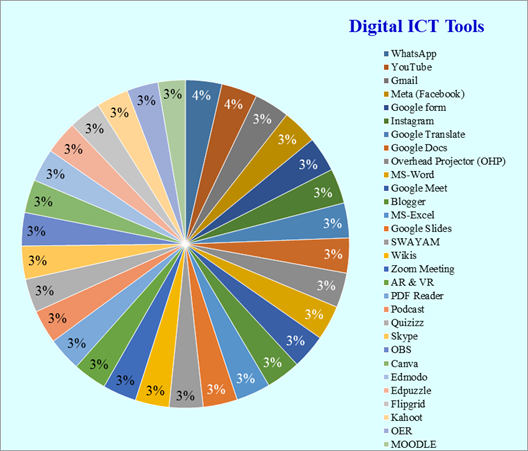
Figure 1. Use of Digital ICT Tools by
Teachers of Secondary Level Education
Graphical presentation
(vide Figure 1) reflects that use of Digital ICT Tools by teachers of secondary
level education minimum up to 3%, such as use of MOODLE, OER, Kahoot, Flipgrid,
Edpuzzle, Edmodo, Canva, OBS, Skype, Quizizz, Podcast, PDF Reader, AR & VR,
Zoom Meeting, Wikis, SWAYAM, Google Slides, MS-Excel, Blogger, Google Meet,
MS-Word, Overhead Projector (OHP), Google Docs, Google Translate, Instagram,
Google form, Meta (Facebook), and Gmail; and maximum up to 4%, such as, use of
WhatsApp and YouTube.
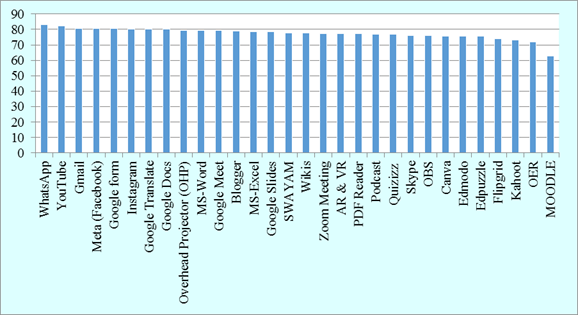
Figure 2. Use of Digital ICT Tools by
Teachers of Secondary Level Education
Descriptive statistics
(vide Figure 2), reflects that most of the teachers, 83.11% (n=90) has use of
WhatsApp at the highest level, 82.22 % teachers has use of YouTube at the
second highest level, while the use of MOODLE is for 62.67% teachers, which
shows the lowest level of Uses. MOODLE, OER, Kahoot, Flipgrid, Edpuzzle,
Edmodo, Canva, OBS, Skype, Quizizz, Podcast, PDF Reader, AR & VR, Zoom
Meeting, Wikis, SWAYAM, Google Slides, MS-Excel, Blogger, Google Meet, MS-Word,
Overhead Projector (OHP), Google Docs, Google Translate, Instagram, Google
form, Meta (Facebook), Gmail were used of Digital ICT Tools for more than
average, more than 62.67% of teachers under secondary education in Uttar
Dinajur district.
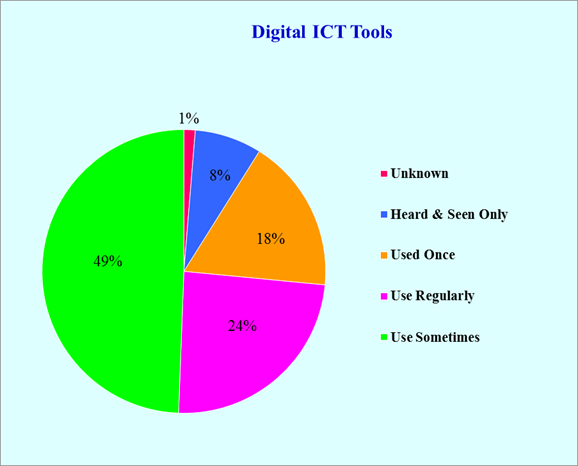
Figure 3. Use of Digital ICT Tools by
Teachers of Secondary Level Education
Graphical presentation
(vide Figure 3) showed that it was found that 49% of teachers were Use Sometimes of Digital ICT Tools and 24% of teachers were
belonging on Use Regularly position and 18% of teachers were Used Once and 8%
of teachers were Heard & Seen and 1% of teachers were Unknown of Digital
ICT Tools.
It was concluded that
secondary-level teachers made use of digital ICT tools. To enhance understanding,
a graph was generated from the collected data, illustrating the distribution of
these teachers.
Finding for the
objective-2:
Table 2
Use of Digital ICT Tools among teachers based
on gender
|
Gender |
N |
Mean |
SD |
df |
‘t’ value |
‘p’ value |
Remarks at 0.05 level |
|
Male |
62 |
115.85 |
11.96 |
88 |
-.422 |
.674 |
Not Significant |
Based on Table 2, data
analysis was conducted for the second objective shows at the 0.05 level of
significance, the calculated t-value of -.422 is not significant (p =.674).
Therefore, the null hypothesis (H02), ‘There is no significant difference
between Male and Female teachers of secondary level education towards the use
of digital ICT tools’ was accepted. As a result, it became clear that there is
no significant difference in how male and female secondary school teachers use
modern digital ICT tools.
Finding for the
objective-3:
Table 3
Use of Digital ICT Tools
among teachers under the Board
|
Board |
N |
Mean |
SD |
df |
‘t’ value |
‘p’ value |
Remarks at 0.05 level |
|
WBBSE |
45 |
116.00 |
10.81 |
88 |
-.164 |
.870 |
Not Significant |
On the basis of the Table
3, analysis of data for the second objective shows the computed t-value was
-.164 which is not significant at 0.05 significance level (p=.870). Therefore,
the null hypothesis (H03), ‘There is no significant difference between teachers
of WBBSE and WBBME board towards the use of digital ICT tools’ was accepted.
Thus, it was revealed that there is no significant difference between WBBSE and
WBBME board towards the use of digital ICT tools.
Finding for the objective
4:
Table 4
Difference on the mean
scores of Digital ICT Tools among the teachers with respect to their category
|
Category |
N |
Mean |
SD |
Source of Variation |
Sum of squares |
df |
Mean square |
‘F’ Value |
‘p’ value |
|
|
General |
38 |
114.63 |
12.31 |
Between Groups |
314.10 |
3 |
104.70 |
.788 |
.504 |
|
|
OBC |
25 |
116.40 |
12.17 |
Within Groups |
11420.30 |
86 |
132.79 |
|
||
|
SC |
17 |
119.76 |
8.64 |
Total |
11734.40 |
Not
Significant at
0.05 level |
||||
It is clear from Table 4
the mean scores of Digital ICT Tools among teachers, who belong to the social
category of General is 114.63 and standard deviation
is 12.31. Moreover, the mean scores of Digital ICT Tools among teachers, who
belong to the social category of OBC, SC and ST is respectively 116.40, 119.76
and 115.60 and standard deviation is respectively
12.17, 8.64 and 10.91.
However, the calculated
value of F is significant at every level (F = .788; p >
0.05). Therefore, the null hypothesis is accepted. Therefore, there is no
significant difference among teachers mean scores on Digital ICT Tools and
their social category. Thus, the teachers mean scores of Digital ICT Tools
level do not differ with respect to their social category.
Conclusions
On the basis of the
findings, a survey of digital ICT tools in teacher education provides valuable
insights into how technology is shaping the landscape of teacher training and
professional development. The integration of digital ICT tools is
revolutionizing how educators are trained and equipped for the classroom. These
tools enhance pedagogy, facilitate collaboration, and provide new avenues for
professional growth. However, it's essential for teacher educators to stay
updated on emerging trends and continuously adapt their programs to best
prepare future teachers for the evolving educational landscape.
References
Corporan,
R. A., Joo-Nagata, J., Martín García, A. V., & Martín, A. H. (2020).
Perception of teachers on collaborative tools knowledge level mediated by ict
and their experience with students. International Journal of Emerging
Technologies in Learning, 15(11), 137-161. https://doi.org/10.3991/IJET.V15I11.13121
García-Martín,
S., & García-Martín, J. (2022). Use of ICT in Compulsory Secondary
Education. Advantages and Disadvantages. Human Review. International Humanities
Review / Revista Internacional de Humanidades, 11. https://doi.org/10.37467/revhuman.v11.3965
García-Valcárcel,
A., Basilotta, V., & López García, C. (2014). ICT in collaborative learning
in the classrooms of primary and secondary education. Comunicar, 21(42), 65-74.
https://doi.org/10.3916/C42-2014-06
Ghavifekr,
S., Ahmad Zabidi Abd Razak., Muhammad Faizal A., Ghani., Ng Yan Ran., Yao
Meixi., & Zhang Tengyue. (2014). ICT Integration In Education:
Incorporation for Teaching & Learning Improvement. Malaysian Online Journal
of Educational Technology, 2(2), 24-45. https://files.eric.ed.gov/fulltext/EJ1086419.pdf
Hew,
K. F., & Cheung, W. S. (2013). Use of Web 2.0 technologies in K-12 and
higher education: The search for evidence-based practice. Educational Research
Review, 9, 47-64.
http://sttechnology.pbworks.com/w/file/fetch/67600627/Hew_(2012)_Use%20of%20Web%2020%20technologies%20in%20K12.pdf
Hughes,
J. (2005). The role of teacher knowledge and learning experiences in forming
technology-integrated pedagogy. Journal of Technology and Teacher Education,
13(2), 277-302. https://www.learntechlib.org/noaccess/26105/
Kaur,
K. (2023). Teaching and Learning with ICT Tools: Issues and Challenges.
International Journal on Cybernetics & Informatics, 12(3), 15-22. https://doi.org/10.5121/ijci.2023.120302
Khajuria,
R., Sharma, A., & Sharma, A. (2023). A detailed survey regarding the usage
of different ICT technology modes adopted by higher education institutions.
Indonesian Journal of Electrical Engineering and Computer Science, 29(3), 1634-1641.
https://doi.org/10.11591/ijeecs.v29.i3.pp1634-1641
Koehler,
M. J., Mishra, P., Kereluik, K., Shin, T. S., & Graham, C. R. (2014). The
technological pedagogical content knowledge framework. In Handbook of Research
on Educational Communications and Technology (pp. 101-111). Springer.
König,
J., Jäger-Biela, D. J., & Glutsch, N. (2020). Adapting to online teaching
during COVID-19 school closure: teacher education and teacher competence effects
among early career teachers in Germany. European Journal of Teacher Education,
43(4), 608-622. https://doi.org/10.1080/02619768.2020.1809650
Li,
S., Yamaguchi, S., & Takada, J.-I. (2018). Understanding factors affecting
primary school teachers’ use of ICT for student-centered education in Mongolia.
International Journal of Education and Development Using Information and
Communication Technology, 14(1), 103-117. https://files.eric.ed.gov/fulltext/EJ1178363.pdf
Mouza,
C. (2012). Preparing teachers to integrate technology using the technological,
pedagogical, and content knowledge framework. Journal of Digital Learning in
Teacher Education, 28(2), 54-62.
Nieveen,
N., & Kuiper, W. (2019). Using the TPACK framework to analyze the processes
of student teacher educators' design of technology-rich teaching. Journal of
Educational Computing Research, 57(4), 999-1025.
Ricardo-Barreto,
C., Molinares, D. J., Llinás, H., Santodomingo, J. P., Acevedo, C. A.,
Rodríguez, P. A., Navarro, C. B., & Villa, S. V.(2020). Trends in using ict
resources by professors in heis (higher education institutions). Journal of
Information Technology Education: Research, 19, 395-425. https://doi.org/10.28945/4601
Stare,
J., Klun, M., & Dečman, M. (2023). A Case Study on the Development of
Digital Competences of Teachers at the University of Ljubljana. NISPAcee Journal
of Public Administration and Policy, 16(1), 138-166. https://doi.org/10.2478/nispa-2023-0006
Thompson,
A. D., & Schmidt, D. A. (2010). Technological pedagogical content knowledge
(TPACK) in action: A descriptive study of secondary teachers' curriculum-based,
technology-related instructional planning. Journal of Research on Technology in
Education, 42(3), 299-325.
Valverde-Berrocoso,
J., Fernández-Sánchez, M. R., Dominguez, F. I. R., & Sosa-Díaz, M. J.
(2021). The educational integration of digital technologies preCovid-19:
Lessons for teacher education. PLoS ONE, 16(8). https://doi.org/10.1371/journal.pone.0256283
Yusuf,
M. O., & Balogun, M. R. (2020). Student-Teachers’ Competence and Attitude
towards Information and Communication Technology: A Case Study in a Nigerian
University. Contemporary Educational Technology, 2(1), 18-36. https://doi.org/10.30935/cedtech/6041