ICONOGRAPHIC STUDY OF MAHAVIRA IMAGES IN MADHYA PRADESH
DR. ARDHENDU RAY
Assistant Professor, Department
of History,
Chatra Ramai Pandit Mahavidyalaya
Bishnupur, West Bengal.
E-mail- ray.ardhendu82@gmail.com, Mob- 9647401847
ABSTRACT
This paper explores the historical and iconographic
evolution of Jainism in Madhya Pradesh from its inception around the 6th
century BCE to the medieval period. Jainism, which emphasizes non-violence and
universal compassion, developed in response to the ritualistic and hierarchical
Vedic traditions. Archaeological evidence of Jainism's early presence in Madhya
Pradesh is sparse, with notable findings from the Gupta period onwards. Key
discoveries include inscribed Tirthankara images from Vidisha, illustrating the
spread and development of Jain art. During the Gupta era, Deogarh emerged as a
significant center for Jain art, which continued to flourish under the
Candellas in the 9th century, leading to the construction of iconic Jain
temples at Khajuraho. The paper provides detailed iconographic analysis of
various Mahavira images, highlighting their stylistic transitions from Kushan
to Gupta periods and their continued evolution in medieval times. These
artifacts underscore the rich artistic heritage and the socio-religious
patronage that sustained Jainism in this region.
KEYWORDS: Jainism, Madhya Pradesh, Tirthankara Mahavira,
Iconography, Gupta Era.
INTRODUCTION
Jainism, an ancient Indian religion emphasizing ahimsa (non-violence) and
universal compassion, emerged circa 6th century BCE. This indigenous faith developed as a reaction
against perceived ritualistic excesses and social stratification within later
Vedic traditions. The term
"Jainism" originates from "Jina," signifying
"conqueror" – specifically, one who has mastered internal passions
and achieved spiritual liberation.
Adherents of this tradition are known as Jainas. During the lifetime of Mahavira, a key figure
in Jainism, its geographical reach remained limited to regions he traversed,
encompassing parts of eastern Uttar Pradesh, Bihar, and West Bengal.
HISTORICAL BACKGROUND
Archaeological evidence on the spread of Jainism in
Madhya Pradesh during the pre-Christian era is limited. Jaina literary
tradition mentions the city Vidisha, where an image of Tirthankara Mahavira was
worshipped as Jivantasvami. This image was reportedly brought by King Pradyota
of Avanti from Roruka (Bajpai, 1984: 16). Unlike Buddhist remains, Jaina
remains from the early centuries of the Christian era are not found in Madhya
Pradesh. The discovery of three inscribed Tirthankara images from the Vidisha region
provides the first evidence of Jainism during the early Gupta era in Madhya
Pradesh, particularly in Vidisha. The pedestal inscription mentions
Maharajadhiraja Ramagupta. A detailed iconographical study of these Jaina
sculptures shows similarities with the Tirthankara and Buddhist images of
Mathura, dating to the transitional period or early Gupta era.
During the later Gupta period, the Jaina art tradition
continued, evidenced by the image of Parsvanatha carved during the reign of
Kumargupta I in cave no. 20 of Udaigiri near Vidisha (Bajpai, 1984: 16-18).
Deogarh became a significant center of Jaina art during the Gupta era. The
history of Jainism after the Guptas is unclear, but evidence reappears during
the Gurjara-Pratihara period. Under the Candellas, Jainism flourished around
the ninth century, with the Jaina temples of Khajuraho and the sculptural and
inscriptional evidence indicating a prosperous period. During this time,
Jainism prospered and Jaina art developed under royal patronage (Bajpai, 1977:
81-84). In the medieval period, trading communities also supported this
religious ideology, leading to the construction of numerous sculptures and
temples.
Mahavira was the son of Siddhartha and Trisala, leaders
of the Jnatr clan of the Kshatriyas of Kundapura (Kundagram), possibly a suburb
of ancient Vaishali. Also known as Vardhamana, he was the twenty-fourth and
last tirthankara of Jainism. The exact birthplace of Mahavira is uncertain,
with historians identifying three possible locations in Bihar: Kundagram in
Vaishali district, Lachhuar in Jamui, and Kundalpur in Nalanda. Most modern
historians agree that Basokund was his birthplace. Traditionally, Kundalagrama
in ancient Vaishali is regarded as his birthplace, though its exact location is
unknown. Mahavira's symbol is the lion, and he is associated with Yaksha
Matanga and Yakshi Siddhayika. He attained nirvana at Pavapuri. The earliest
representation of the Jina in Indian art, found in Mathura, dates to the Kushan
period. From the Kushan period onward, images of Mahavira have been discovered
across India with various iconic details.
This overview of Jainism history includes an examination
of the iconographic details of some images of the twenty-fourth Tirthankara
Mahavira from Madhya Pradesh.
The earliest Mahavira image from Madhya Pradesh is
located at Sira Pahari, near Nachna. This site is known for a Gupta period Siva
shrine. Within this temple complex, a group of Gupta age Jaina sculptures is
preserved. Among them is a seated Tirthankara with a large halo and flying
gandharvas on each side. The Tirthankara is flanked by standing chamara-dhara
(flywhisk bearers). The head and body treatment of the Jaina figure is similar
to Mathura sculptures of the fourth century. The pedestal features miniature lions
at the ends and a dharmachakra in the center. This seated Tirthankara likely
represents Mahavira with the lion symbol. The style reflects a transition from
typical Kushan types to the classical Gupta idiom. The Mahavira image is a
beautiful specimen, with the face especially well-modeled, dating to the 3rd -
6th century AD.
The Raipur Mahant Ghasidas Memorial Museum in
Chhattisgarh holds a notable white sandstone Mahavira sculpture from Karitalai
region, Jabalpur (Fig. 1). The image, measuring 115 cm x 65 cm, depicts the
Tirthankara seated in padmasana in Dhyanamudra on a high pedestal. The hair is
curly with an usnisa in the center. The image has elongated earlobes touching
the shoulders and a clear facial expression. The srivatsa is present on the chest.
The top and right portions of the prabhamandala and other pratiharyas are
broken and lost; however, miniature representations of some Jainas suggest the
image was intended to be a Chaturvimsati-patta. The pedestal shows a chakra and
a lion (lanchana) in the center between the lions representing the simhasana.
Below the chakra and lanchana is a reclining lady figure, possibly the image
donor. The pedestal also features miniature representations of Matanga and
Siddhayika, the yaksha and yakshi of Mahavira, at its ends. This image is
stylistically dated to the 11th - 12th century AD.
At Khajuraho, nine images of
Tirthankar Mahavira (Fig. 2) have been found, dated to the 10th-12th century
A.D. All images of Mahavira feature lanchana, but yaksha and yakshi are present
in six images. Sarvanubhuti and Ambika are the most commonly depicted yaksha
and yakshi. Among these sculptural specimens of Mahavira, the Khajuraho museum
displays two notable images. In both images, the composition of space is
integrated, and the steles of Tirthankaras are highly decorated. One of these
images is partially damaged, with the head of the Jina missing. In both cases,
the Jina is seated in padmasana posture (dhyanamudra) with meditative eyes, on
a decorated circular cushion placed on a throne with a cover or mat draping
down in front. The cushions are adorned with floral motifs, and the center of
the hanging mats depicts the decorative kirtimukha, commonly found on the top
of steles from the period. Both Tirthankaras bear a stele figure and exhibit
sophisticated carving. The facial expressions of the mulanayakas are clear. The
Jainas have elongated ear-lobes, and their hair is arranged in schematic curls
with an usnisa. The lion, the lanchana of the lord, is depicted in front of the
auspicious wheel in the center of the lower part of the pedestal of both
images. In one case, four-armed yaksha and yakshi figures are carved at both
corners of the pedestal. Stylistically, both images are assignable to the
11th-12th century A.D.
The Chanderi museum houses three
images of Tirthankara Mahavira recovered from the Budhi Chanderi region. The
first image, made of buff sandstone, measures 102x30x21 cm. Mahavira, the 24th
Tirthankara, is depicted standing in kayotsarga-mudra on a tri-ratha simhasana.
The stele behind the head is missing, and his right hand is broken. His head
features curly hair, and his cognizance, the lion, is depicted on the pedestal.
The srivatsa adorns his chest. Male chauri-bearers and kneeling devotees stand
near his feet on either side. His Sasanadevatas and devi are shown on the right
and left lateral projections, with kneeling devotees near their feet. The
second image, measuring 212x58x38 cm and made of red sandstone, also depicts
Mahavira standing in kayotsarga-mudra on a tri-ratha simhasana. His head
features curly hair, and his cognizance, the lion, is depicted on the pedestal.
The srivatsa adorns his chest. Male chauri-bearers and kneeling devotees stand
near his feet on either side. The prabhamandala is flanked by male attendants,
although the attributes in their hands are no longer discernible. The halo is
topped by a tri-chatra, flanked by flying vidyadharas carrying garlands and
accompanied by their consorts. A now obliterated seated figure of a drummer
once appeared above the parasol. The lateral projections of the pedestal bear
seated images of yaksha-yakṣi on the right and left, respectively.
The third image of Mahavira, measuring 110x59x47 cm and made of red
sandstone, is broken from the knee, with only the lower part remaining. The
image was originally life-size. His cognizance, a lion galloping to the left,
helps identify the Tirthankara as Mahavira. He is shown standing on a tri-ratha
lion throne. His yaksha-yakshi, Matanga and Siddhayika, are shown in lalitasana
on the lateral projections of the pedestal. The heads of the kneeling devotees
near his feet are missing. Additionally, there are some sandstone images of
Tirthankara Mahavira currently kept in the Chhappan Mahal complex (museum) of
the Mandu fort in district Dhar. These images are very badly damaged, making it
difficult to trace their iconic details. However, in all cases, the Tirthankara
is seated in padmasana posture (dhyanamudra).
BRONZE IMAGES FROM STATE MUSEUM,
BHOPAL
In 1992, a hoard of eighty-seven
Jaina bronzes was unearthed by a farmer while ploughing a field in Bhopawar
village in Sardarpur tahsil of Dhar district. The bronzes date to the 10th
– 11th centuries and recall a glorious age of pilgrimages and temple building actively organized by the great Jaina Gachhas under
the benevolent care and encouragement of the Paramara rulers are often
gratefully acknowledged in the inscription of Jain temples of Bhojpur,
Gyaraspur, Un, Dhar and Mandu from 10th to 13th
centuries. The collection of eighty seven bronzes is unique in that images of
twenty-four tirthankaras from Lord Adinatha to Lord Mahavira (Fig. 3) are
sequentially complete and largely intact.
MAHAVIRA IMAGES OF MADHYA PRADESH
FROM FOREIGN MUSEUMS
An image of Tirthankara Mahavira
(Fig. 4) is housed in the Rubin Museum of Art, New York. The image measures
114.3 x 68.6 x 30.5 cm and is made of red sandstone. In this depiction,
Mahavira is standing as mulanayaka, seated in padmasana posture (dhyanamudra)
with meditative eyes, on a decorated circular cushion placed on a throne with a
draping cover in front. The cushion features floral motifs. The center of the
hanging mat displays a decorative kirtimukha, commonly found in the top portion
of stele sculptures from the period. The Tirthankara has a stele figure and
sophisticated carving. The facial expression of the mulanayaka is more lucid.
The Jaina has elongated earlobes and his hair is arranged in schematic curls
with an usnisa. He bears the srivatsa symbol on the center of his chest,
resembling the shape of a diamond. The abdomen is well represented, especially
compared to other Jaina figures from this region. The lion, the lanchana of the
lord, is depicted on the triratha pedestal. In the middle of the stele, the
mulanayaka is flanked by two regal chauri bearers, standing in the divanga
posture and half-turned towards the saintly teacher. They are positioned over a
crouching elephant. Their left hand is in katyavalambita posture, and the right
hand holds a fly-whisk. They wear deeply incised loincloths, short and
elaborate jewelry including hara, armlets, wristlets, and ekavali.
The mulanayaka features a leaf-shaped circular siraschakra, with its tips
touching the inner border and a beaded outer border. A similar design of the
siraschakra is seen in Jaina sculptures. Above the head of the mulanayaka, a
trilinear chatra is depicted. The tri-chatra is flanked by figures of flying
vidyadharas with garlands, accompanied by their consorts. The triple parasol is
surmounted by a drummer figure, flanked by elephants with riders. The right
side of the upper portion of the rectangular stele is significantly damaged.
Parallel to the vidyadhara couples, both sides of the upper part of the stele
are decorated with miniature figures of Tirthankaras, positioned one above
another.
CONCLUDING REMARKS
Madhya Pradesh is a significant center for Jainism in
India. Evidence from Durjanpur, Gyaraspur, Ujjain, and other sites indicates
that Jainism dates back to the pre-Gupta period. The images of four
Tirthankaras—Adinath, Neminath, Parsvanath, and Mahavira—are especially
prominent from early times. Among these, images of Mahavira are infrequently
found until the later historical period. However, they are more common compared
to earlier times. Iconographical studies of Mahavira images from Madhya Pradesh
show that most are in a seated posture with dhyana mudra. The Tirthankara is
typically seated on a high pedestal with a lion emblem. A systematic investigation
is required to address the rarity of Mahavira images in this region.
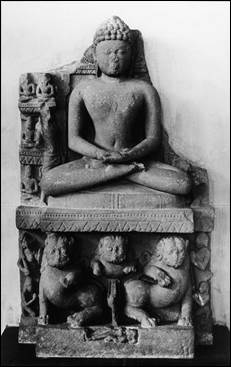
Fig.1. Tirthankara Mahavira from
Mahant Ghasidas Memorial Museum of Chhattisgarh.
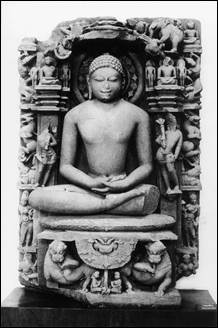
Fig. 2. Tirthankara Mahavira from Khajuraho Museum.
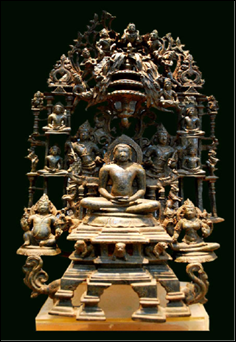
Fig. 3. Tirthankara Mahavira 11th
Century AD (Bronze), State Museum, Bhopal.
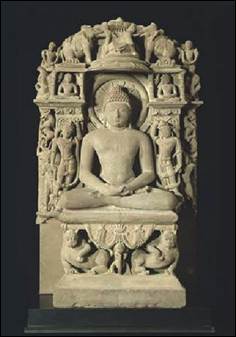
Fig. 4. Tirthankara Mahavira from Rubin Museum of Art, New York.
REFERENCES
- Bajpai,
K. D. (1977). Development of Jaina Art in Madhya Pradesh. Journal of
Indian History & Archaeology, 81-84.
- Bajpai,
K. D. (1975). Central India. In A. Ghosh (Ed.), Jaina Art and
Architecture (Vol. II, Part VII, pp. 349-354). New Delhi: Bharatiya
Jnanpitha.
- Bajpai,
K. D. (1984). Jaina Art of Madhya Pradesh. Puratan, 1(2&3),
16-21.
- Bajpayee,
M. (1989). Development of Jaina religion in Madhya Pradesh (From the
earliest times to c. 1200 AD.). Delhi: Ramanand Vidya Bhavan.
- Bhattacharya,
B. C. (1939). The Jaina Iconography. Lahore.
- Chatterjee,
A. K. (1978). A Comprehensive History of Jainism (upto 1000 AD.).
Calcutta: Firma KLM Pvt. Ltd.
- Deshpande,
M. N. (1974). The Background and Tradition. In A. Ghosh (Ed.), Jaina
Art and Architecture (Vol. I, Part I, pp. 14-21). New Delhi: Bharatiya
Jnanpitha.
- Deva,
K. (1974). Central India. In A. Ghosh (Ed.), Jaina Art and Architecture
(Vol. I, Part IV, pp. 168-179). New Delhi: Bharatiya Jnanpitha.
- Jain,
B., et al. (1975). Museums in Madhya Pradesh. In A. Ghosh (Ed.), Jaina
Art and Architecture (Vol. III, Part X, pp. 577-595). New Delhi:
Bharatiya Jnanpitha.
- Majumdar,
R. C., Pusalkar, A. D., & Majumdar, A. K. (Eds.). (1993). The Age
of Imperial Kanauj. Bombay: Bharatiya Vidya Bhavan.
- Shah,
C. J. (1989). Jainism in North India. New Delhi: A Sagar Book
House.
- Nagar,
S. L. (1999). Iconography of Jaina Deities. Delhi: B.R. Publishing
Corporation.
- Nagar,
S. L. (2000). Jaina Sculptures in India and World Museums. New
Delhi: Kalinga Publications.
- Nahar,
P., & Ghosh, K. (1988). Jainism, Precepts and Practice (Vols. I
& II). Delhi: Caxton Publication.
- Shah,
U. P. (1974). Central India. In A. Ghosh (Ed.), Jaina Art and
Architecture (Vol. I, Part III, pp. 127-134). New Delhi: Bharatiya
Jnanpitha.
- Shah,
U. P. (1975). Iconography (canons and symbolism). In A. Ghosh (Ed.), Jaina
Art and Architecture (Vol. III, Part IX, pp. 465-493). New Delhi:
Bharatiya Jnanpitha.
- Tiwary,
M. N. P. (1983). Elements of Jaina Iconography. Varanasi:
Indological Book House.