IS FOREIGN DIRECT INVESTMENT- A NEW
ENGINE FOR GROWTH AND ECONOMIC DEVELOPMENT OF INDIA?
Dr.
Sathvik S1
1Assistant
Professor, Department of Commerce and Management
School
of Agribusiness and Rural Development, skill and Entrepreneurship Development
Karnataka
state Rural Development and Panchayat Raj University, Karnataka.
ABSTRACT:
Indian
economy is one of the fast-emerging economy across the world with respect to
Foreign direct investments. The development of any nation doesn’t happen
overnight Foreign direct investment is a major vehicle for cash inflows into
India economy. FDI is a major driving force and source for the development of
any economy. Every year we are experiencing growth of FDI inflows into India.
Post liberalization period India has witnessed major changes in the business
activities, economy growth and capital formation during pre-liberalization
period there was no conducive environment for conducting any business activity
due to high tariffs, restrictive trade practices, restriction on import. After
introducing liberalization, privatization and globalization policy in the year
1991, India has shifted focus towards outward oriented policy as well reduced
restrictions on trade policies, import duties etc for feasibility of doing
business. The flow of FDI inflows has arose from 4,029 Crore rupees in 2001 to
89,930 Crore rupees till 2023 june. In this research article author has made an
attempt to present the statistical data pertaining to FDI inflows into India, besides
this he made an attempt to understand the year wise equity flows into economy,
state wise and sector wise attracting high FDI inflows into India. The aim of
the present study is to understand the significance of Foreign direct
investment inflows in development of India. The present study uses secondary
data related to FDI investments which has been collected from DPIIT website and
other published articles with the help of well defined inclusion and exclusion
criteria. The results of the study reveals that service sector stood first with
16.33% of total equity flows in USD terms and it was observed that Maharashtra
is attracting highest 4,43,961 cumulative equity flows from October,2019-
june,2023.
Keywords: Foreign Direct Investments,
Liberalization, DPIIT, Inclusion and Exclusion criteria.
INTRODUCTION:
Formation of
capital is key determinant for any economic activity and it is essential for
the development of economy and the economic development of nation is
represented by its GDP. Investments from domestic sources fuels capital stock
in any country while, Foreign direct investment is one of the major source of overall
capital formation. FDI bridges the gap between domestic investments and
savings. MNC’s act as vehicles for mobilizing funds and bring all the economies
across globe. Indian economy is one of the major developing economy in the
world with respect to Foreign direct investments. The development of any nation
doesn’t happen overnight. Foreign direct investment is a major vehicle for cash
inflows into India economy. FDI is a major driving force and source for the
development of any economy. Every year we are experiencing growth of FDI inflows
into India. Post liberalization period India has witnessed major changes in the
business activities, economy growth and capital formation during
pre-liberalization period there was no conducive environment for doing any business
activity due to high tariffs, restrictive trade practices, restriction on
import. After introducing liberalization, privatization and globalization in
the year 1991, India has shifted focus towards outward oriented policy as well
reduced restrictions on trade policies, import duties etc for feasibility of
doing business. The flow of FDI inflows has arose from 4,029 Crore rupees in
2001 to 89,930 Crore rupees till 2023 June.
COMPONENTS
OF FDI:
FDI comprises of
three major components viz, equity capital, re-invested gains and other sources
of capital or term loans between intra-companies. FDI cash inflows are
represented as net capital account. The difference between credits – debit
transfers between direct investors as well as foreign investors associated with
financial year. FDI is allowed in two major methods i.e, Automatic route and
Government route. FDI inflows raised from automatic route don’t need any
approval from Indian Government to invest in any company. Without government
interference one can invest in any sectors such as financial services, railway,
insurance, construction and so on. Under government route FDI inflows need approval
from Indian government. Sectors like Print media, banking-public, satellite
operations etc require approval from government. There is no similar rates of
FDI in India depends on sector/ industry the percentage of investments varies
49%, 51%, 74% in few industries 100% FDI investments are allowed which
signifies the investments from foreign entities. In few sectors like Defence
and telecom through government and automatic routes only 49% FDI’s are allowed.
Sectors such as tobacco industry, betting and gambling, Chits and nidhi
companies etc are restricted FDI’s in both routes.
LIBERALIZATION
AND FDI INVESTMENTS:
Indian economic
reforms influence significantly in shaping the development of India, prior to
liberalization of economic reforms, investment policies are not conducive for FDI
because of tariffs, government interference on import duties, restrictions on
imports later in the year 1991, LPG has brought major changes in economic
activities FDI investments upto 51% allowed under automatic route in 34 major
sectors. During 2012, FDI limit has increased to 100% in retail sector govt
route where as, 51% FDI is permitted for multi-brand retail segment. Government
has launched skill India and Make in India to boost FDI investments these
initiatives attracted FDI inflows to India.
REVIEW
OF LITERATURE:
Bajpai
and Dasgupta (2004) examined FDI flows in china and India
examined the pattern over a period of years by major Multinational companies
and made an attempt to understand the possibilities for attracting investments
from foreign companies there by India can formulate policies to attract foreign
direct investments. Goswamia and Saikiab
(2012) an attempt is made to understand the relationship that exists between
exports and FDI explored the major trends in FDI. Anitha (2012) in their research work authors have examined relationship between FDI inflows and
Economic growth findings of their study revealed that FDI plays an important
role in limiting the gap between present and future requirement of funds and
FDI is very important source for financing funds for under-developing and
developing nations. Azhar S (2012)
examined FDI flows into India and impact on economic growth, they found that
especially during the recent times FDI in India is following positive growth rate
FDI is a major determinant which drives economic growth of India. Patil and Kadam (2014) an attempt is
made to understand relevance of FDI on economic development of India over the
years 2001-2010 and explained the importance of role of FDI in economic
development through their observations. Teli BR (2014) in their research work
an attempt is made to understand the growth rate of FDI investments and
findings of the works represents Mauritius and Singapore stands top in FDI
investments and service sector is major to receive FDI flows. Author opines
that Government of India should design flexible business policies and to remove
restrictions on investments which help to bring fresh investments which
benefits Indian economy. Vyas AV (2015) found
that FDI inflows are major sources of investments for capital formation and economic
development of India. FDI helps in creating employable opportunities in many
sectors for skilled workforce besides this FDI’s in Banking and insurance
sector strengthen Indian financial system FDI helps to raise the productivity
and output. Singh S (2019) opines
Indian economy is fast emerging economy in the world since 2014, foreign
countries are looking towards India for Investments through FDI flows, these
flow of funds will help India in advancement of technology, up gradation of
skills, technology transfer, employment generation and better infrastructure. Rakhi (2020) author has made an attempt
to analyse FDI trends in India findings of the study reveals that India is top
9th nation to receive FDI in 2020 finally author concludes the study
with the positive impact of FDI on India economic development.
PROBLEMATIC:
So far many research
works has been carried out in this area pertaining to the inconsistency of fund
flows into Indian economy hence, it is very important to assess the trends of
FDI in developing Indian economy and also to understand the major states
attracting higher FDI inflows, to analyze the major industries where FDI
inflows are allowed through automatic and government route in India and to
identify the sectors prohibited FDI investments in India.
OBJECTIVES
OF THE STUDY:
1.
To examine the recent trends in FDI
inflows into India economy.
2.
To analyze the major sectors attracting
FDI in India.
3.
To identify the states which attract
highest FDI Inflows.
4.
To understand the investment pattern of
top countries towards FDI Inflows.
RESEARCH
METHODOLOGY:
Present study pertaining to FDI inflows is purely
quantitative in nature. Author has collected secondary data from Department of
Industrial and promotion policy, RBI etc and other online sources were used to
collect required to meet the objectives set forth by author, Besides he used
articles published pertaining to FDI is collected from databases like ebsohost,
peer-reviewed journals and e-sources has been referred. Well defined inclusion
and exclusion criteria is used to collect the data inclusion criteria helps
author to collect the data related to Indian FDI investments articles published
in English language are used and recent data has been collected from DIPP.
Articles published in multiple nations are excluded only Indian works are
reviewed.
Tools
used: To assess the FDI trends author has used percentage
and CAGR (Compounded Annual Growth Rate) is used to examine the quantitative
data. Author intends to present figures of FDI in percentages to give
comprehensive understanding about FDI inflows in India.
DATA
ANALYSIS AND INTERPRETATION:
Chart-1.
Represents the cumulative FDI inflows into India

(Source: internet)
Interpretation:
The above graph
depicts the flow of FDI inflows from 2001-2023. The FDI inflows are drastically
increased. We can understand that economic reforms and flexi policies of
business favorable business policies has attracted multinational companies to
invest in India. Even India has seen up’s and down’s in FDI investments during
the instances of 2008 global economic recession, 2012-13 European crisis and
2019-2020 pandemic crisis, witnessed gradual surge in FDI inflows in India.
During 2014 government of India took initiatives such as start up India, Skill
India also boost the FDI growth.
Chart-2 Represents the FDI Equity
Inflows in US dollars
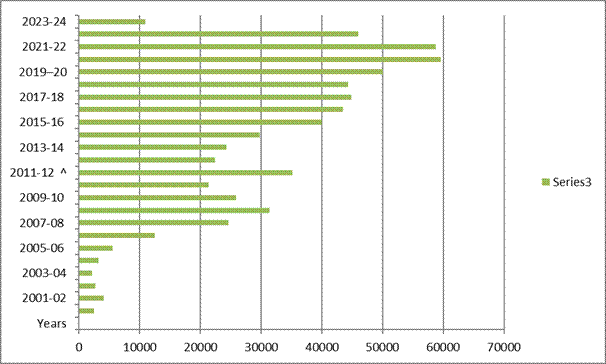
Interpretation:
The above exhibit
represents cumulative equity inflows deducting the investments remitted through
RBI and NRI schemes. It was found that inconsistency in growth rate of FDI
equity inflows over a period of time, there is a positive growth rate and also
observed down trends in FDI equity also the reasons may be covid-19 pandemic
crisis, changes in investment pattern may be the reasons.
|
I.
CUMULATIVE FDI FLOWS INTO INDIA (2000-2023): |
||||
|
A. TOTAL
FDI INFLOW (from April, 2000 to JUNE, 2023): |
||||
|
1 |
CUMULATIVE FDI INFLOWS |
|
USD 9,71,521
Million |
|
|
|
||||
|
|
|
|||
|
2 |
CUMULATIVE FDI EQUITY INFLOWS |
INR 42,44,132 Crore |
USD 6,66,477 Million |
|
|
|
||||
|
B.
FIRST QUARTER FDI INFLOWS FOR THE FINANCIAL YEAR 2023-24 (APRIL, 2023 TO
JUNE, 2023): |
||||
|
1 |
TOTAL FDI INFLOW INTO INDIA |
|
USD 17,960 Million |
|
|
|
||||
|
|
||||
|
2 |
FDI EQUITY INFLOW |
INR 96,154 Crore |
USD 11,549 Million |
|
|
C.
MONTH-WISE FDI EQUITY INFLOWS FOR THE FINANCIAL YEAR 2023-24: |
||||
|
Financial Year 2023-24 |
Amount of FDI Equity inflow |
|||
|
( April – JUNE) |
(In INR Crore) |
(In USD mn) |
||
|
1 |
April, 2023 |
41,877 |
5,106 |
|
|
2 |
May, 2023 |
22,055 |
2,678 |
|
|
3 |
June, 2023 |
25,999 |
3,162 |
|
|
2023-24 (from April, 2023 to JUNE, 2023) # |
89,930 |
10,946 |
||
|
2022-23 (from April, 2022 to JUNE, 2022) # |
1,27,823 |
16,589 |
||
|
%age growth over last year |
-30% |
-34% |
||
Source:
DPIIT publications
The above table describes
the facts of FDI flows month-wise from April –June 2023 -34% changes has been
found in FDI equity inflows over the last three months.
|
D. SHARE OF TOP
INVESTING COUNTRIES FDI EQUITY INFLOW (Financial year): |
||||||||||
|
|
||||||||||
|
Rank |
Country |
Amt. in Rupees Crores/ Amt. in USD Million |
2021-22 |
2022-23 |
2023-24 |
Cumulative Equity Inflow
* |
%age out of total FDI
Equity inflow |
|||
|
1 |
Mauritius |
Rupees Crores |
69,945 |
48,895 |
58,433 |
10,14,876 |
|
|||
|
USD Million |
9,392 |
6,134 |
7,042 |
1,70,918 |
26% |
|||||
|
2 |
Singapore |
Rupees Crores |
1,18,235 |
1,37,374 |
61,505 |
10,55,902 |
|
|||
|
USD Million |
15,878 |
17,203 |
7,443 |
1,55,612 |
23% |
|||||
|
3 |
U.S.A. |
Rupees Crores |
78,527 |
48,666 |
23,432 |
4,29,346 |
|
|||
|
USD Million |
10,549 |
6,044 |
2,835 |
63,031 |
9% |
|||||
|
4 |
Netherland |
Rupees Crores |
34,442 |
19,855 |
18,765 |
3,02,213 |
|
|||
|
USD Million |
4,620 |
2,498 |
2,278 |
46,037 |
7% |
|||||
|
5 |
Japan |
Rupees Crores |
11,187 |
14,328 |
22,567 |
2,58,628 |
|
|||
|
USD Million |
1,494 |
1,798 |
2,735 |
41,475 |
6% |
|||||
|
6 |
United Kingdom |
Rupees Crores |
12,283 |
13,994 |
7,589 |
2,00,823 |
|
|||
|
USD Million |
1,657 |
1,738 |
918 |
34,794 |
5% |
|||||
|
7 |
UAE |
Rupees Crores |
7,699 |
26,315 |
20,160 |
1,27,118 |
|
|||
|
USD Million |
1,032 |
3,353 |
2,430 |
18,008 |
3% |
|||||
|
8 |
Cayman Islands |
Rupees Crores |
28,383 |
6,069 |
1,780 |
1,06,859 |
|
|||
|
USD Million |
3,818 |
772 |
215 |
15,139 |
2% |
|||||
|
9 |
Germany |
Rupees Crores |
5,421 |
4,417 |
3,041 |
86,734 |
|
|||
|
USD Million |
728 |
547 |
368 |
14,506 |
2% |
|||||
|
10 |
Cyprus |
Rupees Crores |
1,735 |
10,184 |
6,627 |
79,378 |
|
|||
|
USD Million |
233 |
1,277 |
796 |
13,441 |
2% |
|||||
|
TOTAL FDI EQUITY INFLOW FROM ALL COUNTRIES |
Rupees Crores |
4,37,188 |
3,67,435 |
2,65,030 |
42,44,132 |
|
||||
|
USD Million |
58,773 |
46,034 |
32,037 |
6,66,477 |
- |
|||||
|
||||||||||
Source: DPIIT
From the above table we
can observe that Mauritius Stood top followed by Singapore and Netherlands in
FDI equity inflows and other has considered only top ten nations contributed
for FDI equity inflows.
|
E. SECTORS ATTRACTING
HIGHEST FDI EQUITY INFLOW |
|||||||||||
|
Rank |
Sector |
Amt. in Rupees Crores/ Amt. in USD Million |
2021-22 |
2022-23 |
2023-24 |
Cumulative Equity Inflow
* |
%age out of total FDI
Equity inflow |
||||
|
1 |
SERVICES SECTOR ** |
Rupees Crores |
53,165 |
69,852 |
42,822 |
6,74,807 |
|
||||
|
USD Million |
7,131 |
8,707 |
5,187 |
1,08,042 |
16% |
||||||
|
2 |
COMPUTER SOFTWARE & HARDWARE |
Rupees Crores |
1,07,762 |
74,718 |
28,250 |
6,81,029 |
|
||||
|
USD Million |
14,461 |
9,394 |
3,417 |
98,329 |
15% |
||||||
|
3 |
TRADING |
Rupees Crores |
33,779 |
38,060 |
22,082 |
2,89,261 |
|
||||
|
USD Million |
4,538 |
4,792 |
2,661 |
42,192 |
6% |
||||||
|
4 |
TELECOMMUNICATIONS |
Rupees Crores |
4,980 |
5,469 |
2,229 |
2,34,752 |
|
||||
|
USD Million |
668 |
713 |
271 |
39,315 |
6% |
||||||
|
5 |
AUTOMOBILE INDUSTRY |
Rupees Crores |
51,624 |
15,184 |
7,547 |
2,30,212 |
|
||||
|
USD Million |
6,994 |
1,902 |
913 |
35,657 |
5% |
||||||
|
6 |
CONSTRUCTION (INFRASTRUCTURE) ACTIVITIES |
Rupees Crores |
24,178 |
13,588 |
31,826 |
2,36,304 |
|
||||
|
USD Million |
3,248 |
1,703 |
3,841 |
33,527 |
5% |
||||||
|
7 |
CONSTRUCTION DEVELOPMENT: Townships, housing, built-up infrastructure
and construction-development projects |
Rupees Crores |
932 |
1,196 |
1,538 |
1,30,747 |
|
||||
|
USD Million |
125 |
146 |
185 |
26,541 |
4% |
||||||
|
8 |
DRUGS & PHARMACEUTICALS |
Rupees Crores |
10,552 |
16,654 |
7,592 |
1,33,628 |
|
||||
|
USD Million |
1,414 |
2,058 |
913 |
22,377 |
3% |
||||||
|
9 |
CHEMICALS (OTHER THAN FERTILIZEINR) |
Rupees Crores |
7,202 |
14,662 |
6,370 |
1,33,089 |
|
||||
|
USD Million |
966 |
1,850 |
770 |
22,072 |
3% |
||||||
|
10 |
POWER |
Rupees Crores |
3,904 |
5,483 |
13,155 |
1,08,010 |
|
||||
|
USD Million |
526 |
698 |
1,583 |
18,168 |
3% |
||||||
|
|||||||||||
From the above exhibit it
is found that service sector is attracting more FDI investments 16% followed by
computer hardware and software by 15% and trading and telecommunication 6%
respectively on top 3 FDI investments.
|
Rank |
Sector |
Amt. in
Rupees Crores/ Amt. in USD Million |
2021-22 |
2022-23 |
2023-24
|
Cumulative
Equity Inflow * |
% age
out of total FDI Equity inflow |
|
|
1 |
MAHARASHTRA |
Rupees Crores |
1,14,964 |
1,18,422 |
36,634 |
4,43,961 |
||
|
USD Million |
15,439 |
14,806 |
4,460 |
58,431 |
29% |
|||
|
2 |
KARNATAKA |
Rupees Crores |
1,63,795 |
83,628 |
12,046 |
3,47,103 |
||
|
USD Million |
22,072 |
10,429 |
1,466 |
45,927 |
23% |
|||
|
3 |
GUJARAT |
Rupees Crores |
20,169 |
37,059 |
5,993 |
2,45,018 |
||
|
USD Million |
2,706 |
4,714 |
729 |
32,630 |
16% |
|||
|
4 |
DELHI |
Rupees Crores |
60,839 |
60,119 |
15,358 |
2,05,451 |
||
|
USD Million |
8,189 |
7,534 |
1,868 |
27,061 |
14% |
|||
|
5 |
TAMIL NADU |
Rupees Crores |
22,396 |
17,247 |
5,181 |
69,268 |
||
|
USD Million |
3,003 |
2,169 |
631 |
9,133 |
5% |
|||
|
6 |
HARYANA |
Rupees Crores |
20,971 |
20,735 |
4,056 |
63,528 |
||
|
USD Million |
2798 |
2,600 |
494 |
8,316 |
4% |
|||
|
7 |
TELANGANA |
Rupees Crores |
11,964 |
10,319 |
6,829 |
42,595 |
||
|
USD Million |
1,607 |
1,303 |
831 |
5,576 |
3% |
|||
|
8 |
JHARKHAND |
Rupees Crores |
48 |
44 |
79 |
19,371 |
||
|
USD Million |
6 |
6 |
10 |
2,666 |
1% |
|||
|
9 |
RAJASTHAN |
Rupees Crores |
5,277 |
7,218 |
785 |
16,643 |
||
|
USD Million |
707 |
910 |
96 |
2,174 |
1% |
|||
|
10 |
WEST BENGAL |
Rupees Crores |
3,195 |
3,217 |
438 |
11,335 |
||
|
USD Million |
428 |
394 |
53 |
1,482 |
1% |
Source:
DPIIT
From the above table it is
observed that Maharastra ranked 1st in FDI inflows with 29% ,
Karnataka stood second with 23% , followed by Gujarat with 16% above 3 states ranked highest FDI investments
in top 3.
PRINCIPLE
FINDINGS OF THE STUDY:
1. FDI
is a major determinant that helps in capital formation as well as in
development of Indian economy.
2. Cumulative
amount of Equity FDI inflows excluding RBI and NRI remmitance is 40,69,033 Crore
rupees.
3. FDI
cumulative equity flows for the first quarter i.e, April –June,2023 Stands at 89,930 Crore rupees.
4. Mauritius
stood first among top ten countries in attracting FDI equity inflows with 26%,
Singapore 23% and USA 9% respectively during the first quarter from April,2023-
June,2023.
5. Service
sector is the major sector to attract the FDI inflows during first quarter with
16% equity inflows, computer hard ware and software segment constitute 15% of
equity inflows in FDI investments.
6. Maharashtra
is state which attracted more FDI inflows for first quarter with 29%, followed
by Karnataka 23% and Gujarat constitutes 16% of FDI inflows during April,2023-
June,2023.
7. It
was observed that there was no uniformity or consistency in growth rate of FDI
inflows into Indian economy. Every year there is growth rate as well as
decreased in percentage of Inflows are observed.
8. Government
of India has taken major initiatives like start-up India, Skill India and other
initiatives helps to strengthen FDI inflows into India.
9. FDI
is a major investment vehicle through companies and nation forms long term
source of capital and it is important for the growth and development of India.
CONCLUSION:
India is a country with
huge potential to attract FDI inflows, for the development of economy it is observed
that a flexible business policy framed by the government has helped to foster
FDI inflows. From the results of the data analysis we can understand the
importance of FDI in economic development of India. India should focus on Long
term financing sources rather than short run. Investor friendly environment has
to be created for feasibility of investments. India has to consider the
potential sectors where foreign investments has to be generated from automatic
routes. Since service sector and Hard ware and soft ware sectors playing a
pivotal role in attracting investments in such sectors favorable policies can
also draft for such sectors. It can be suggested that researchers can do
research in this area still there is broader scope. The limitation of the
present study is only simple percentage and CAGR is used, in future works other
statistical tools can used for analyzing financial data.
REFERENCES:
1. Anitha, R. (2012). Foreign Direct
Investment and Economic Growth in India. International Journal of Marketing,
Financial Services & Management Research, 1(8).
2. Azhar, S. and Marimuthu, K. (2012).
An Overview of Foreign Direct Investment in India. EXCEL International Journal
of Multidisciplinary Management Studies,
3. Bajpai, N. and Dasgupta, N. (2004),
“Multinational Companies and Foreign Direct Investment in China and India”,
Columbia Earth Institute, Columbia University, Working Paper No. 2.
4. Goswamia, C. and Kanta Saikiab, K. (2012). FDI
and its relation with exports in India, status and prospect in north east
region. Procedia - Social and Behavioral Sciences, 37, pp.123-132.
5. Patil, D. and Kadam, S. (2014). Effects of FDI
on Indian Economy: A Critical Appraisal. Journal of Economics and Sustainable
Development, 5(19).
6. kumar, V. “ Trend of FDI in India
& Its impact on economic growth(2014) “ , international journal of science
& research , vol.3,issue 10.
7. Singh, S. (2019) “Foreign direct
investment inflows in India “, journal of general management research, ISSN-
2348-2869, vol. 6, issue 1, pp. 41-53.
8. Teli, R.B.(2014) “a Critical analysis
of foreign direct investment inflows in India”, procedia- social and behavioral
science .
9. Indiabefore.91.in
10. Press information bureau, govt. of
India cabinet “ cabinet approves proposal for review of FDI policy on various
sector”.
11. UNCTAD report (2018) “Investment and new industrial
policies”, united nations publication, ISSN 1020-2218.
12. UNCTAD REPORT (2020) “ Investment
trends monitor” ,issue 33 10) World investment report (2019) “ Special economic
zone”
13. NCAER annual report 2018-19
14. Economic survey 2019-2020
15. Raj, T. & Pahwa, A.(2018)s “
impact of foreign investment on economic growth of India” , research review
international journal of multidisciplinary”, vol.03,issue-12