AN
ANALYSIS ON ACCOUNTING EDUCATION AND NATIONAL EDUCATION POLICY RESEARCH
Ms. Deeksha Chaurasia1,
Dr. Punnam Veeriah2 Dr. Sunil S. Desai3
1Assistant
Professor, Department of Business and Commerce,
Pandit
Sunderlal Sharma Central Institute of Vocational Education (PSSCIVE), Bhopal.
2Professor
& Head Department of Business and Commerce,
Pandit
Sunderlal Sharma Central Institute of Vocational Education (PSSCIVE), Bhopal,
3Assistant Professor, Dr. Ghali
College,
Gadinglanj,
Dist. Kolhapur, Maharashtra,
ABSTRACT
Accounting education plays a crucial role
in shaping the future of finance professionals. It encompasses a wide range of
topics, including financial reporting, auditing, taxation, and management
accounting. A strong foundation in accounting principles is essential for
individuals pursuing careers in finance, auditing, consulting, and other
related fields. National education policies have a significant impact on how
accounting education is structured and delivered. These policies are formulated
by governments to outline the goals, objectives, and strategies for education
at the national level. They influence curriculum design, teaching methods,
assessment practices, and overall educational standards. The
methodology of this paper is based on primary data and secondary data. A
structured questionnaire was designed and data was collected from educators, academicians.
The data was analyzed and interpreted by applying descriptive statistics. The
study will help to analyses the impact of National Education Policy on accounting
education. The
research paper involves a systematic approach to gather information, analyze
data, and present findings.
Key
Words: National Education Policy, strong
foundation, teaching methods, educational standards
INTRODUCTION
Accounting
education refers to the formal process of learning and acquiring knowledge and
skills related to accounting principles, practices, and procedures. It is a
crucial aspect of preparing individuals for careers in accounting, finance, and
related fields. Accounting education typically starts with teaching fundamental
concepts such as double-entry bookkeeping, financial statements, and basic
accounting principles like the accrual basis of accounting. Technical Skills
provides training in the use of accounting software, spreadsheets, and other
tools necessary for recording, organizing, and analyzing financial data.
Students learn
about the various regulatory frameworks and standards that govern financial
reporting, such as Generally Accepted Accounting Principles (GAAP) and
International Financial Reporting Standards (IFRS). Emphasis is placed on
ethical considerations in accounting practice, including issues related to
honesty, integrity, and confidentiality. Accounting education often offers
specializations in areas like auditing, taxation, management accounting,
forensic accounting, and financial analysis, allowing students to focus on
specific career paths. Students are trained to analyze financial information,
identify issues, and make informed decisions based on the data available. Effective
communication of financial information, both in writing and orally, is a vital
component of accounting education. This includes preparing reports,
presentations, and financial statements. Many accounting programs are designed
to prepare students for professional certifications like Certified Public
Accountant (CPA), Chartered Accountant (CA), Certified Management Accountant
(CMA), and others. Given the evolving nature of accounting standards and
practices, accounting professionals often engage in ongoing education and
professional development to stay updated with industry changes. With the
increasing use of technology in accounting, modern accounting education often
includes training in accounting software, data analytics, and other
technological tools. Some programs incorporate experiential learning through
internships, case studies, or simulated business scenarios to give students
hands-on experience. As businesses operate in a globalized world, accounting
education may include an international perspective, considering the
implications of different accounting standards and practices around the world.
For advanced studies in accounting, research skills are emphasized, enabling
students to contribute to the body of knowledge in the field through academic
research.
Accounting
education aims to foster adaptability in graduates, recognizing that the
accounting profession is subject to continuous change. Overall, accounting
education equips individuals with the knowledge and skills needed to perform
various accounting functions, whether in public accounting firms, corporations,
government agencies, non-profit organizations, or as independent practitioners.
It serves as the foundation for a wide range of careers in finance and accounting-related
fields.
The National
Education Policy (NEP) of 2020 has a significant impact on the field of
accounting education in India. It introduces several reforms and initiatives
aimed at modernizing and enhancing the quality of accounting education. The NEP
encourages a multidisciplinary approach in higher education, allowing students
to pursue a diverse range of subjects alongside their chosen field of study,
including accounting. The policy emphasizes flexibility in course selection,
allowing students to customize their education to suit their interests and
career goals within the field of accounting. The NEP advocates for the
integration of vocational education, including specialized courses in
accounting, from the secondary level onwards. This allows students to gain
practical skills alongside academic learning. The NEP places a strong emphasis
on experiential learning, which is particularly valuable in accounting
education where practical skills are crucial. The policy promotes the use of
technology in education. In accounting, this may include training in accounting
software, data analytics tools, and other relevant technologies. The NEP
encourages research and innovation in education, which can lead to advancements
in accounting education methodologies, curriculum design, and practices. The
NEP emphasizes the importance of inculcating ethical values and professionalism
in education. In accounting, this is particularly relevant as ethical conduct
is fundamental to the profession. The policy highlights the need for continuous
training and professional development of teachers. In accounting education,
this ensures that educators stay updated with industry practices and standards.
The NEP acknowledges the importance of financial literacy and aims to integrate
it into the curriculum. This is particularly relevant in accounting education,
where understanding financial concepts is essential. The policy encourages a
global perspective in education. In accounting, this may involve studying
international accounting standards and practices. The NEP emphasizes the
development of critical thinking and problem-solving skills, which are highly
valuable in accounting where complex financial issues often require analytical
solutions. The NEP seeks to align education with the needs of the industry. In
accounting, this means preparing students for the demands of the accounting
profession and related fields.
Overall, the NEP 2020 provides a framework that
supports the modernization and enhancement of accounting education in India. It
aims to produce well-rounded accounting professionals who are equipped with not
only technical skills but also critical thinking abilities, ethical values, and
a global perspective. These changes are expected to have a positive impact on
the quality and relevance of accounting education in the country.
REVIEW OF LITERATURE
The literature review is basically a
belief on the collection of information that the researcher has learned from
others and build our own beliefs based on the work and knowledge of other researchers.
The research provides that the conclusions drawn todays researches are being
made similar efforts in past researches. Literature review by different authors
shows that they had an in-depth grasp on the key words skill development practices,
challenges, issues and prospects which are as under:
Nicholas
J. Paisey (2003) , An analysis of accounting education
research in accounting education: an international journal – 1992–2001, This report examines the research
papers published in the first 10 volumes of Accounting Education: an
international magazine since its founding in 1992, highlighting both those
areas that have been adequately addressed and those that offer prospects for
additional study. The study contrasts coverage with American accounting
education research that has been released. The document is intended to be of
interest to researchers who seek to establish the existing literature on their
study themes or who are looking for research topics and/or methodologies that
have previously gone unexplored. In order to acquire a deeper understanding of
the condition of accounting education research at the beginning of the
twenty-first century, the study also offers some insights concerning the
techniques used and the sources of the studies. Deb, P. (2020) ,
“Vision for Foreign Universities in the National Education Policy 2020: A
Critique” that deals with the internationalization of Indian higher education
as one of the stated aims of the National Education Policy (NEP) 2020. Aithal
(2020) , “Analysis of the Indian National Education Policy 2020 toward
Achieving its Objectives” and highlighted various policies announced in the
higher education system and likened them with the currently adopted system.
Various innovations and predicted implications of NEP 2020 on the Indian higher
education system along with its merits are discussed. Some suggestions are
proposed for its effective implementation towards achieving its objectives. Ponemon, Lawrence; Glazer, Alan (2021), Accounting Education and Ethical Development: The
Influence of Liberal Learning on Students and Alumni in Accounting Practice,
This study looks at the ethical growth of
undergraduate accounting students and graduates from two colleges that have
vastly different curriculum, educational philosophies, and working cultures.
Both colleges provide undergraduate accounting degrees. The study investigates
the impact of a college education and work experience on a person's ethical
development by drawing from the field of moral psychology and employing a
well-known psychometric tool called the Defining Issues Test (DIT).
RESEARCH OBJECTIVE
- To
assess the awareness of educators regarding the National Education Policy
(NEP) introduced in 2020.
- To
examine the level of understanding among educators regarding the key
provisions of the NEP,2020 as it pertains to accounting education.
- To
investigate the impact of the NEP,2020 on the quality of accounting education
in India from the perspective of educators.
- To
identify any observed changes in the curriculum or teaching methodologies
in accounting education post the implementation of NEP,2020.
- To
identify specific areas within accounting education that require further
research attention under the NEP,2020.
RESEARCH DESIGN
The
study employs a descriptive research approach, utilizing a case study
methodology. Data is collected through questionnaire with key stakeholders
involved in the Analysis on Accounting Education and National Education Policy
Research. The data is analyzed using thematic analysis to identify patterns and
themes related to the implementation process and its outcomes. Therefore, the study aims to fulfil
the parameters of analytical and descriptive research in nature.
DATA COLLECTION
Primary data is collected with the help of questionnaire
from stakeholders. Stratified Random sampling method was applied, and samples
are collected from 50 teachers/educators. Various statistical tools were
applied in this research paper. In this study, a review of
secondary sources like government reports, newspaper/ news channels, magazines
have also been used for comparing the information collected from the
respondents in primary data.
STUDY PERIOD
The study period
for data collection is from January, 2022 to October, 2023. The study was
conducted post the implementation of the National Education Policy (NEP) in
2020.
RESULT
AND ANALYSIS
For this present study the data was
collected from teacher’s, to discovery the awareness
of national education policy (NEP), impact of NEP on accounting education,
challenges and opportunities, teaching and learning methods, research and
development, recommendations and future outlook.
Section 1: Awareness of National Education Policy
(NEP)
1.
Are you familiar with the National
Education Policy (NEP) introduced in 2020?
Table
No 1.1
|
|
Frequency |
Percent |
|
Yes |
50 |
100% |
|
No |
0 |
0% |
|
Total |
50 |
100% |
Figure
No 1.1

The above chart shows the
awareness of NEP,2020 among educators. I am glad to note that 100% educators
are familiar with the National Education Policy (NEP) introduced in 2020. This
shows that educators are aware what changes are been brought up in NEP,2020.
2.
How well-informed are you about the
key provisions of the NEP,2020 as it pertains to accounting education?
Table
No 1.2
|
|
Not
Aware |
Not
Sure |
Slightly
Aware |
Aware |
Total |
|
Frequency |
0 |
3 |
3 |
44 |
50 |
|
Percent |
0% |
6% |
6% |
88% |
100
% |
Figure
No 1.2

The above chart shows that how educators are well-informed
about the key provisions of the NEP,2020 as it pertains to accounting
education. 88% educators are aware about the latest change in accounting
education. 6% educators are not clear what exactly changes in NEP 2020. 6%
educators are partially aware about the accounting education.
Section 2: Impact of NEP on Accounting Education
1. In
your opinion, how has the NEP,2020 influenced the quality of accounting
education in India?
Table
No 1.3:
|
|
Positively |
Negatively |
No
noticeable impact |
Not Sure |
Total |
|
Frequency |
46 |
2 |
1 |
1 |
50 |
|
Percent |
92% |
4% |
2% |
2% |
100 % |
Figure
No 1.3:
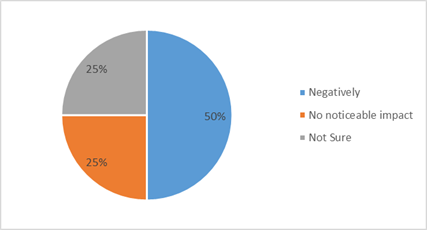
The above chart
depicts the impact of NEP in accounting Education.50% educators are in favor
that NEP,2020 influenced the quality of accounting education in India whereas
25% educators did not notice any change with the implementation of NEP.25%
educators are in negatively favor of NEP.
2. Have
you observed any changes in the curriculum or teaching methodologies in
accounting education post the implementation of NEP,2020? If yes, please
specify.
Following are the
responses received from Educators:
·
Lot of changes are required which are
Practical oriented content should incorporate, On the job training is very much
required, Internship and project based assignment will give to the students,
Activity based content should put and arrange field visits.
·
Question paper pattern is of high level
which is helpful to clear professional of exams
·
Yes, CBSE launched Competency Based
Questions that include current knowledge on business & industry
·
Yes
·
Not Yet
·
No
·
Single regulator for higher education
institutions
·
Multiple entry and exit options in degree
courses
·
Discontinuation of MPhil programs
·
Low stakes board exams
·
Common entrance exams for universities.
Section 3: Challenges and Opportunities
3. What
do you consider to be the main challenges faced by accounting education in
light of the NEP,2020?
·
First challenge facing is not getting
industrial collaboration, second appointment of trained facilities with
industrial exposure, Create interest among the stakeholders for improvement
practical aspects and availability of suitable lab equipment.
·
Vast syllabus
·
No practical experience to the students
·
Basic Accounting knowledge through
practical approach
·
Computerized Accounting system
·
Lack of Approach
·
Awareness on Commerce Education from class
IX onwards as Commerce has been suggested from class IX.
·
Alignment with NEP Goals
·
Integration of Holistic and
Multidisciplinary Education
·
Emphasis on Critical Thinking and Problem
Solving
·
Teacher Training and Professional
Development
·
Infrastructure and Technology Integration
·
Assessment and Evaluation Methods
·
Engagement with Industry and Practical
Application
·
Equity and Inclusivity
4. Are
there any new opportunities that the NEP,2020 has presented for improving
accounting education?
Table
No 1.4:
|
|
Frequency |
Percent |
|
Yes |
40 |
80% |
|
No |
5 |
10% |
|
May Be |
5 |
10% |
|
Total |
50 |
100% |
Figure
No 1.4:
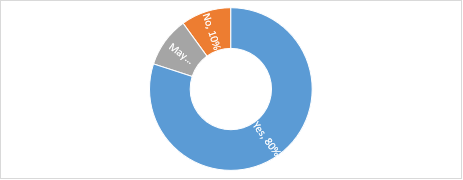
The above sunburst
shows new opportunities that the NEP,2020 has presented for improving
accounting education. 80% of respondents answered "Yes" when asked
there any new opportunities that the NEP,2020 has presented for improving
accounting education 10% of respondents answered "No." Another 10% of
respondents answered "Maybe” there is new opportunities in accounting
education.
Section 4: Teaching and Learning Methods
5. Do
you believe the NEP,2020 encourages innovative teaching and learning methods in
accounting education?
Table
No 1.5:
|
|
Frequency |
Percent |
|
Yes |
42 |
84% |
|
No |
3 |
6% |
|
Not
sure |
5 |
10% |
|
Total |
50 |
100% |
Figure
No 1.5:
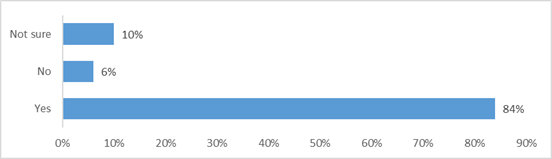
The above chart
shows teaching and learning methods in NEP. 84% educators believe that NEP,2020
encourages innovative teaching and learning methods in accounting education.10%
educators are not sure that NEP has brought
some changes in teaching learning methods. 6% educators are not in favor that
NEP has introduced any creativity.
6. Could
you provide examples of innovative teaching methods that have been implemented
or can be implemented in accounting education under the NEP,2020?
·
Suitable accounting standards framed,
conduct the research on the standards are important, frequently change the
standards and principles according to changes in the business patterns, results
will be analyzed and apply, give suggestions for better implementation of
industrial activities.
·
Demonstration method
·
Nothing implemented
·
Practical approach
·
By Visits to different Industries,
Companies we can Train them
·
No
·
Use of technology, games, group
discussions on business & economics etc.
·
Problem-Based Learning (PBL)
·
Case Studies and Simulations
·
Interactive Workshops and Seminars
·
Technology-Enhanced Learning
·
Flipped Classroom Approach
·
Peer Teaching and Collaborative Learning
·
Industry Internships and Experiential
Learning
·
Gamification
·
Research Projects and Case Analyses
·
Cross-Disciplinary Integration
·
Guest Lectures and Industry Expert
Sessions
·
E-Learning Platforms and Virtual
Classrooms
Section 5: Research and Development
7. How
has the NEP,2020 impacted research initiatives in accounting education?
Table
No 1.6
|
|
Frequency |
Percent |
|
Increased |
29 |
58s% |
|
No noticeable change |
12 |
24% |
|
Decreased |
0 |
0% |
|
Not sure |
9 |
18% |
|
Total |
50 |
100% |
Figure
No 1.6
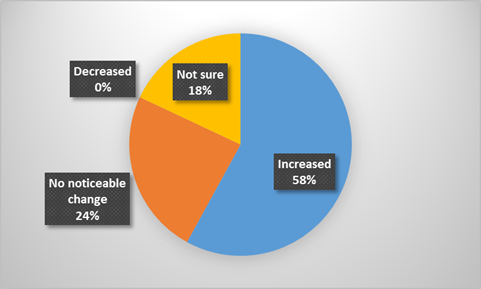
The above chart
shows how NEP, 2020 impact research initiatives in accounting education. 58% of
respondents reported that there has been an increase in their level of
awareness regarding the importance of environmental conservation. 24% of
respondents stated that they have not noticed any significant change in their
level of awareness. None of the respondents reported a decrease in their
awareness. 18% of respondents were unsure about the change in their awareness.
8. Are
there specific areas within accounting education that you believe require
further research attention under the NEP?
Table
No 1.7
|
|
Frequency |
Percent |
|
Yes |
42 |
84% |
|
No |
3 |
6% |
|
Not sure |
5 |
10% |
|
Total |
50 |
100% |
Figure
No 1.7:
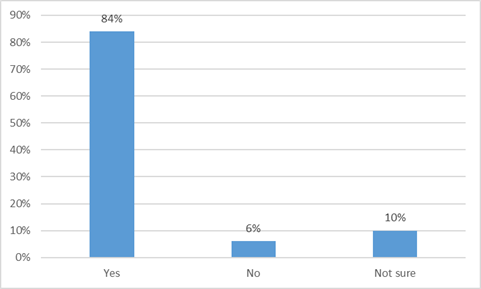
The above chart shows specific areas within accounting education that
require further research attention under the NEP.
84% of respondents believe that there are specific areas within accounting
education that require further research attention under the National Education
Policy (NEP). Only 6% of respondents answered "No," indicating that
they do not believe further research is necessary. Additionally, 10% of
respondents were "Not sure." The total number of respondents is 50.
Section 6: Recommendations and Future Outlook
9.
What recommendations do you have for
policymakers, educators, and institutions to enhance accounting education in
light of the NEP,2020?
·
Students should get those understanding so
that they can work on accounting like tally software.
·
Reduce the syllabus so that students can
be through with given topics
·
Some concepts not related to present
situations. So frame curriculum as per the requirements
·
Research Methodology
·
Practicability
·
Educators
·
Create awareness on the career
opportunities in Commerce field. Industry experts need to be called in the
schools.
·
Align Curriculum with Industry Needs
·
Regularly review and update the accounting
curriculum to ensure it reflects current industry practices, emerging
technologies, and evolving regulatory requirements.
·
Engage with professionals and experts from
the accounting field to gather input on necessary skill sets.
·
Promote Experiential Learning
Opportunities
·
Encourage internships, apprenticeships, and
practical training in accounting firms, corporations, and financial
institutions. These experiences provide students with real-world exposure and
help bridge the gap between theory and practice.
·
Integrate Technology and Digital Literacy
·
Incorporate the use of accounting software,
data analytics tools, and other technological resources into the curriculum.
·
Provide training to both students and
educators to ensure proficiency in digital tools relevant to accounting.
·
Emphasize Critical Thinking and
Problem-Solving Skills
·
Design assignments, projects, and assessments
that require students to analyze complex financial scenarios, make informed
decisions, and solve accounting-related problems.
·
Encourage a culture of inquiry and
analytical thinking.
·
Foster a Multidisciplinary Approach:
Encourage collaboration between accounting departments and other disciplines
like finance, economics, law, and technology. This fosters a broader
understanding of business and financial concepts, aligning with the NEP's
multidisciplinary focus.
·
Incorporate Ethical Considerations and
Professional Values
·
Integrate discussions on ethical dilemmas,
professional conduct, and corporate governance into the curriculum.
·
Encourage students to think critically about
ethical issues in accounting practice.
·
Provide Continuous Professional
Development for Educators
·
Offer training and workshops for accounting
educators to keep them updated on industry trends, teaching methodologies, and
technological advancements. This ensures that educators are well-equipped to
deliver high-quality instruction.
·
Facilitate Research and Innovation in
Accounting Education: Encourage faculty and students to engage in research
projects related to accounting education. Support initiatives that explore
innovative teaching methods, assessment practices, and educational
technologies.
·
Promote Inclusivity and Accessibility
·
Implement policies and practices that ensure
equal access to accounting education for students from diverse backgrounds.
·
Provide support systems for students who
may face barriers to participation.
·
Offer Flexible Learning Pathways
·
Provide options for flexible course
scheduling, online learning, and part-time programs to accommodate the needs of
a diverse student population. This supports lifelong learning and accessibility
for working professionals.
·
Foster Industry Partnerships and Guest
Lectures
·
Collaborate with accounting firms,
corporations, and industry associations to provide guest lectures, workshops,
and networking opportunities. This exposes students to real-world professionals
and environments.
·
Evaluate and Monitor Outcomes so that
regularly assess the effectiveness of accounting education programs in
achieving learning outcomes and career readiness.
·
Use feedback from employers, alumni, and
industry stakeholders to inform continuous improvement efforts.
10. How
do you envision the future of accounting education in your country, considering
the influence of the NEP,2020?
·
Holistic and Multidisciplinary Approach
·
Emphasis on Practical Application
·
Technology Integration
·
The NEP
encourages experiential learning. In accounting education, this could mean more
hands-on activities, case studies, and simulations to apply theoretical
knowledge to real-world situations.
·
Accounting education is likely to become more
holistic, integrating knowledge from related fields like finance, economics,
law, and technology. This multidisciplinary approach will provide students with
a broader understanding of the business environment.
·
There will likely be a greater emphasis on
incorporating technology into accounting education. This includes using accounting
software, data analytics tools, and other technology platforms to prepare
students for the digital demands of the profession.
·
Critical Thinking and Problem-Solving Skills
·
The NEP's focus on critical thinking and
problem-solving will translate into accounting education.
·
Students will be challenged to analyze financial
data, make informed decisions, and address complex accounting issues.
·
Educators may adopt more innovative approaches, such
as flipped classrooms, interactive workshops, and collaborative learning, to
engage students and promote deeper understanding.
·
Innovative Teaching Methods
·
Ethical Awareness and Professional Values
·
Flexibility
in Learning Pathways
·
There will likely be an increased emphasis on
instilling ethical awareness and professional values in accounting education,
aligning with the NEP's goal of producing responsible and ethical citizens.
·
The NEP supports flexible learning options.
Accounting education may become more adaptable, offering online courses,
part-time programs, and alternative pathways to accommodate diverse student
needs.
·
Continuous Professional Development for Educators
·
Accounting
educators may receive more support and opportunities for professional
development to stay updated on industry trends, teaching methodologies, and
technological advancements.
·
Research and Innovation in Accounting Education
·
There may be
a surge in research initiatives focused on improving accounting education, including
studies on effective teaching methods, assessment strategies, and the impact of
technology integration.
·
Global Perspective in Accounting Curriculum
·
With an increasingly globalized business
environment, accounting education may incorporate international accounting
standards, global business practices, and cross-border financial reporting
considerations.
·
Inclusive and Accessible Education
·
Efforts to
ensure inclusivity and accessibility in accounting education may be further
emphasized, aiming to provide equal opportunities for students from diverse
backgrounds.
·
Outcome-Oriented Education so that there may be an
increased emphasis on measuring learning outcomes and preparing students for
successful careers in accounting, with a focus on employability and practical
skills.
CONCLUSION
In conclusion, this analysis delves into the
intersection of Accounting Education and the National Education Policy,2020
aiming to understand the implications of the policy on the field of accounting
education. The National Education Policy of 2020, with its emphasis on
multidisciplinary, experiential learning, and technology integration, presents
a transformative framework for education in India.
Within the realm of accounting education, these
policy reforms hold significant promise. The emphasis on vocational education
and the integration of practical skills alongside theoretical knowledge
addresses a longstanding need in the field. Moreover, the policy's focus on
research and innovation aligns with the dynamic nature of accounting standards
and practices, encouraging educators and professionals to contribute to the
evolving landscape.
The encouragement of ethical values and
professionalism in education resonates deeply with the ethos of the accounting
profession. Instilling these principles from the foundational stages of
education can contribute to a culture of integrity and responsibility within
the accounting community.
However, as with any policy implementation,
challenges and nuances will undoubtedly emerge. It will be imperative for
educators, policymakers, and practitioners to collaborate in navigating these
complexities, ensuring that the policy's vision translates into tangible
benefits for accounting education.
Looking forward, the successful integration of the National
Education Policy into accounting education has the potential to produce a new
generation of accounting professionals who are not only technically adept but
also possess critical thinking skills, ethical awareness, and a global
perspective. As the policy takes root and evolves, it is poised to shape a
brighter future for accounting education in India.
SCOPE FOR FUTURE RESEARCH
Conduct a longitudinal study to track the long-term
impact of the NEP,2020 on accounting education in India, considering factors
such as curriculum changes, teaching methodologies, and student outcomes over
time. Compare the effectiveness of accounting education under the NEP,2020 with
previous education policies to assess improvements and areas of concern.
Investigate the perspectives of other stakeholders such as students, employers,
and policymakers to gain a comprehensive understanding of the implications of
the NEP,2020 on accounting education. Explore the impact of the NEP,2020 on the
employability and career outcomes of accounting graduates, including their
readiness for the workforce and alignment with industry needs. the
effectiveness of technology integration in accounting education under the
NEP,2020, including the adoption of accounting software, data analytics tools,
and online learning platforms. Examine efforts to promote inclusivity and
accessibility in accounting education under the NEP,2020, focusing on
addressing barriers faced by marginalized communities and promoting equal
opportunities for all students. Investigate the challenges encountered in the
implementation of the NEP,2020 in the context of accounting education,
including issues related to infrastructure, resource allocation, and
stakeholder engagement.
REFERENCES
1.
National Education Policy 2020, Ministry
of HumanResource Development, Govt. of India. https://www.education. gov.
in/sites/ upload_files /mhrd/files/ NEP_Final_ English_0. pdf.
2.
Aithal, P. S., &Aithal, S. (2020).
Analysis of the Indian National Education Policy 2020 towards Achieving its
Objectives. International Journal of Management, Technology, and Social
Sciences (IJMTS), 5 (2), 19-41.
3.
Jha, P., &Parvati, P. (2020). National
Education Policy, 2020. (2020). Governance at Banks, Economic & Political
Weekly, 55 (34), 14-17.
4.
Braun, V., & Clarke, V. (2006). Using
thematic analysis in psychology. Qualitative Research in Psychology, 3(2),
77-101.
5.
Holloway, I., & Galvin, K. (2016).
Qualitative Research in Nursing and Healthcare. John Wiley & Sons. Aithal,
P. S., &Aithal, S. (2019). Analysis of Higher Education in Indian National
Education Policy Proposal 2019 and Its Implementation Challenges. International
Journal of Applied Engineering andManagement Letters (IJAEML), 3 (2), 1-35.
6.
Sunil Kumar Saroha, &UttamAnand
(2020). New instruction procedure 2020 Highlights: To see huge movements in
schools and advanced edification. IOSR Journal of Humanities and Social Science
(IOSR- JHSS), 25 (8), 59-62.
7.
Singh, H., & Dey, A. K. (2020). Listen
to my story: contribution of patients to their healthcare through effective
communication with doctors. Health Services Management Research. https://
doi.org/10.1177/0951484820952308
8.
Smith, J., Bekker, H., Cheater, F. (2011).
Theoretical versus pragmatic design challenges in qualitative research. Nurse
Researcher, 18(2), 39– 51.
9.
Suryavanshi, S. (2020). Reflections from a
Comparative Study for Reimagining Indian Universities. UNIVERSITY NEWS, 58
(33), 96- 102.
10.
Kumar, K., Prakash, A., & Singh, K.
(2020). How National Education Policy 2020 can be a lodestar to transform
future generation in India. Journal of Public Affairs, 20 (4), e2500. https:
//doi. org/10.1002/pa.2500
11.
Nicholas J.
Paisey (2003), "An analysis of accounting education research in accounting
education: an international journal – 1992–2001"
12.
Deb, P. (2020),
"Vision for Foreign Universities in the National Education Policy 2020: A
Critique"
13.
Aithal (2020),
"Analysis of the Indian National Education Policy 2020 toward Achieving
its Objectives"
14.
Ponemon,
Lawrence; Glazer, Alan (2021), "Accounting Education and Ethical
Development: The Influence of Liberal Learning on Students and Alumni in
Accounting Practice"