THE PLIGHT OF MANUAL SCAVENGERS
M. Ramalakshmi1, Dr.
Darling Selvi2
1Research Scholar, PG & Research
Department of Commerce, Rani Anna Government College for Women, Tirunelveli, ramalakshmimariappan24@gmail.com.77085-61672
2Assistant Professor of Commerce,
Rani Anna Government College for Women, darlingselvi@raniannagcw.edu.in
Abstract:
Scavengers
are poor people who are socially and economically backward. They live an
affluent but unhealthy lifestyle and labour in unsanitary conditions. The
absence of government assistance, insufficient education, underdeveloped
technologies, and religious beliefs regarding scavengers are all incompatible. In
this study the problems of the scavengers, its remedial measures and also need
of changing beliefs and laws related to manual scavengers are analyzed through
factor analysis and weighted. The study was conducted among 80 manual
scavengers who are working in the study area.
A well chalked out Interview Schedule has been prepared and administered among
the sample respondents to gather their opinion.
Keywords:
Beliefs, Backward, Economically, Unhealthy, Unhygienic
Introduction:
The terrible practise of hand-cleaning
continues nearly a century after Mahatma Gandhi originally advocated its
elimination. The Indian Ministry of Social Justice and Empowerment acknowledged
the existence of 676,000 scavengers between 2002 and 2003. (Rajnarayan R.
Tiwari, PMC). However, because scavenging is illegal, these figures may be
underestimated. According to a survey conducted by Bezwada Wilson of the Safai
Karma Chari Association, the country is home to an estimated 12 lakh (1.2
million) scavengers (Kothandaraman P, Vishwanathan V. Sulabh international: A
movement to liberate scavengers by implementing a low-cost, safe sanitation
system, 2007).[Accessed on October 20, 2008]
from http://www.growinginclusivemarkets.org).Sulabh estimates that four to five
million individuals worked as scavengers in 2005, and that local civic
authorities frequently hired them to clean faeces in public locations (Zaidi A.
India's shame. Frontline 9-22 September 2006). Since 2014, India claims to have
built nearly 1,000 lakh toilets under the Swachh Bharat Abhiyan, providing
toilets to around 95 percent of households. The 2011 Socio-Economic Caste
Census indicated that manual cleaning was the principal occupation of 1,82,505
households, which was the lowest reported census (Downtoearth). SubhomaySaha
and VikasUpadhayay's book, The Missing Manual Scavengers in India, was
published on Monday, January 18, 2021. Under the Swachh Bharat
Abhiyan, India claims to have constructed approximately 1,000 lakh toilets
since 2014, thereby providing approximately 95 per cent households with access
to toilets. Despite a 2013 law prohibiting employment of manual scavengers, a
government survey as of July 2019, 54,130 people were involved in the work.Because
the poll was only conducted in locations where "there are reasons to infer
the existence of manual scavengers," the figure is understated. The survey
was done in 170 districts across 18 states [Data: Manual scavenging still
continues in India despite being outlawed in 2013], according to The Hindu. The
National SafaiKaramcharis Finance and Development Corporation (NSKFDC)
performed a survey of manual scavengers in 2018 at the Ministry of Social
Justice and Empowerment's request. This investigation, which revealed 87,913
manual scavengers in India, was limited to 14 Indian state statutory cities.[SubhomaySaha, VikasUpadhayay Published: Monday 18 January 2021].
Manual Scavenging:
The
removal of human feces from public streets is described as wiping by hand and
dry toilets, septic tanks, sewers and drains, manually by humans. It's action Manual
removal of human waste / night sludge from ‘dry toilets’ such as toilets
without modern flush systems.The General Assembly was established during the
British rule Hiring people to remove toilets and defecation was introduced in
India. Municipalities were established and the municipal system was implemented
during colonial authority. Containers were commonly used in bathrooms that had
to be emptied on a regular basis during the time. As a result of the invention
of flush toilets, all other forms of toilets have vanished from the Western
world. However, many underdeveloped countries, like India, continue to follow
this barbaric practise. Caste, class, and revenue and income are used to divide
training.
Causes of manual
scavenging in India:
According
to the renowned Indian writer and social activist Harsh Mander, the failure to
eradicate hand wiping from our country is the greatest humiliation of modern
India and the most despicable practice of untouchability.
Social scarcity:People
born into this profession have experienced societal stigma for years, and
despite welfare programmes and regulations designed to help them, they have
been unable to take advantage of possibilities because they have been ostracized
and reviled. As a result, people who work in this menial, inhumane, and
disgusting occupation become immersed in it and continue to do so for
generations.
Low self-esteem: Being labeled as untouchables, dirty, having
little or no education, being afraid of losing their jobs, and being exploited
from infancy results in low self-esteem.
Continuation of unhygienic toilets:Although
the country is only recently awakening to the need of living in sanitary
circumstances as a human right, the country continues to maintain unclean
latrines in which human waste is physically cleansed rather than flushed or
drained. Cleaning such latrines is done by hand because they are dry toilets
that have not been properly constructed.
Poor enforcement of existing laws: Although there are laws
prohibiting manual scavenging, the problem is that the people who engage in it
are unable to access the criminal justice system due to caste bias among
government employees, police, and society. Sometimes it appears that rules
relating to manual scavenging are not enforced.
Unorganized group:Unlike
most professions that have labor unions, manual cleaners do not have an
organized group or union, so they have no significant voice in the political
process, so the government in the country.
Lack of empathy:One
of the most important factors in this case is the complete lack of sympathy for
the plight of manual cleaners.
Lack of other employment and
rehabilitation:People continue this occupation because
our community and organization cannot rehabilitate these people or include them
in the mainstream of our community. Constitutional provisions against manual
cleaning in India: Human dignity is an inalienable right as part of a
fundamental right. Life under the Constitution of India (Section 21 - Union of
India v. Maneka Gandhi). ‘Dignity’ is considered to include equality and the
protection of the law and equal respect. This is a unanimously accepted right,
verified by Sections 1, 22 and 23 of the Universal Declaration of Human Rights.
Below is a list of the provisions under the Constitution of India that must
meet the rights of equality, dignity and dignity before the law.
Ø Article
14 is about equality before the law, which should not be denied to any
individual in India.
Ø Article
15 provides that no discrimination on the basis of a person's place of birth,
race, religion, caste and gender is allowed. However, manual cleaners face
discrimination because of their caste throughout their lives.
Ø Article
16 of the Constitution of India guarantees equal opportunity to all its
citizens in matters of public employment.
Ø Article
17 contains a way to abolish untouchability, which is guaranteed to all under
this constitutional provision.
Ø Article
19 (1) (g) gives every citizen the right to engage in any occupation, trade or
business of their choice.
Ø Article
21 guarantees life security and personal liberty to all citizens residing in
India.
Ø Apart
from these, under Article 46 and Section 338 of the Constitution of India there
are certain other rights which protect the hand cleaners as SC or ST.
Review of literature:
Rajneesh
Kumar Gautam, Islamuddin, Nandkishor, Mohammad Usama et al, (2017), This
study examines the many sorts of wastes that scavengers deal with, as well as
the working conditions and living standards of those who do scavenging
operations. It also emphasises the need to change attitudes and legislation
around manual scavenging.
Jayalakshmi
(2019), suggest that the surveying
and identifying process was not completed successfully, and that more time and
effort is needed to accomplish this task effectively. When manual scavengers
travel to other parts of the country, they suffer language and cultural
hurdles, making it difficult for them to self-identify as such because they are
often ignorant of the plans and procedures in place.
Ashutosh Singh (2020),
the researcher suggested that the article discusses the situation of manual
scavengers in our country, as well as the toothless law that exists due to a
lack of proper application.
Objective of the study:
1.
To study the job involvement of sanitary
workers.
2.
To give suggestion for the improvement of
sanitary workers.
Research Gap:
According
to the preceding literature studies, the researcher examines the many sorts of wastes
that scavengers deal with, as well as the working conditions and living
standards of those who do scavenging operations, the next researcher said that the surveying and identifying process
was not completed successfully, and that more time and effort is needed to accomplish
this task effectively, and another researcher proposed that the article
discusses the situation of manual scavengers in our country, as well as the
toothless law that exists due to a lack of proper application, However, the
current study, as well as the growing societal challenges and potential
solutions for manual scavengers.
Methodology
of the study:
The manual scavengers are still viewed as second-class citizens in our society, and it is claimed that they are doing a public duty. Their welfare, health, and safety may be investigated. A study based on public knowledge of solid waste management must also be done. A study of how medical waste is disposed in this city may also be conducted. The information was gathered from both primary and secondary sources. A thorough interview schedule was created for the goal of collecting primary data. Secondary data gathering sources include journals, books, periodicals and relevant websites. The acquired data was processed and entered into an SPSS data sheet, after which it was analysed using statistical methods. The study included 80 individuals who work as scavengers in Tirunelveli City. To obtain the opinions of the sample respondents, a well-planned Interview Schedule was created and distributed.
Table 1-Scavengers
Death Rate in India:
|
States |
Number of deaths |
|
Haryana
|
73 |
|
Karnataka
|
78 |
|
Delhi
|
89 |
|
Uttar
Pradesh |
103 |
|
Gujarat
|
161 |
|
Tamil
Nadu |
206 |
|
Others |
210 |
|
All
India |
920 |
Source: Statista
Chart-1 Scavenger’s Death rate
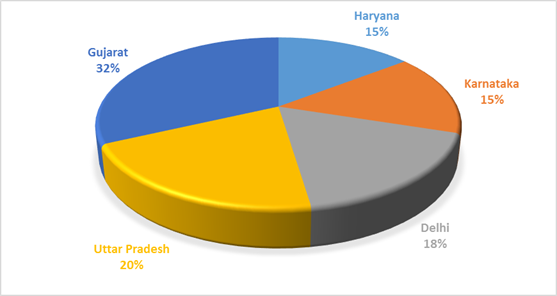
Table-2Demographical profile:
|
Variables |
Frequency |
Percent |
Cumulative
Percent |
|
Age
wise classification |
|||
|
18-30
years |
4 |
5.0 |
5.0 |
|
31-45
years |
45 |
56.2 |
61.2 |
|
46-60
years |
31 |
38.8 |
100.0 |
|
Total |
80 |
100.0 |
|
|
Gender
wise classification |
|||
|
Male |
34 |
42.5 |
42.5 |
|
Female |
46 |
57.5 |
100.0 |
|
Total |
80 |
100.0 |
|
|
Education
Status |
|||
|
Primary |
70 |
87.6 |
87.6 |
|
Secondary |
7 |
8.8 |
96.2 |
|
Higher
Secondary |
1 |
1.2 |
97.5 |
|
Under
Graduation |
2 |
2.5 |
100.0 |
|
Total |
80 |
100.0 |
|
|
Marital
Status |
|||
|
Married |
73 |
91.2 |
91.2 |
|
Unmarried |
7 |
8.8 |
100.0 |
|
Total |
80 |
100.0 |
|
|
Community
wise classification |
|||
|
OC |
3 |
3.8 |
3.8 |
|
SC |
26 |
32.5 |
36.2 |
|
SCA |
51 |
63.8 |
100.0 |
|
Total |
80 |
100.0 |
|
|
Health
Care Camp |
|||
|
Yes |
67 |
83.8 |
83.8 |
|
No |
13 |
16.2 |
100.0 |
|
Total |
80 |
100.0 |
|
Source: Primary Source
Table
1 shows that out of 80 respondents 56.2 percent were age of 46 to 60 years;
38.8 percent were age of 31 to 45 years of old and 5 percent were 18 to 30 year
old, 57.5 percent were female and 42.5 percent were male, 87.6 percent were studied only primary education, 9 percent
were Secondary, 1 percent were Higher Secondary, 3 percent were under
Graduates, 91.2 were married, 8.8 respondents were unmarried, 96 percent
were Hindu and 4 percent were Christian, 63.8 Percent were community group of
SCA, 32.5 percent were SC, 3.8 percent were OC, 83.8 percent were say yes for
conducting health camp, rest of the person say no for conducting health camp.
In the above table majority of the age classification is middle age, in gender
female is higher, most of the scavengers were primary education, majority
people have married, SCA were frequently choosing this job and maximum attend
health care camp.
Table -3: Rank the problems faced by the Scavengers
|
Problems
faced |
Weighted Score |
Weighted Mean Score |
Rank |
|
No social security |
499.00 |
6.2375 |
I |
|
Low literacy |
485.00 |
6.0625 |
II |
|
Low income |
467.00 |
5.8375 |
III |
|
Vulnerable to diseases |
460.00 |
5.7500 |
IV |
|
Downgrading social status |
436.00 |
5.4500 |
V |
|
Insulting |
357.00 |
4.4625 |
VI |
|
Caste and Gender discrimination |
332.00 |
4.1500 |
VII |
|
Social discrimination |
306.00 |
3.8250 |
VIII |
|
Structural violence |
258.00 |
3.2250 |
IX |
Source: Primary Source
CHART-2
Problem faced by the scavengers
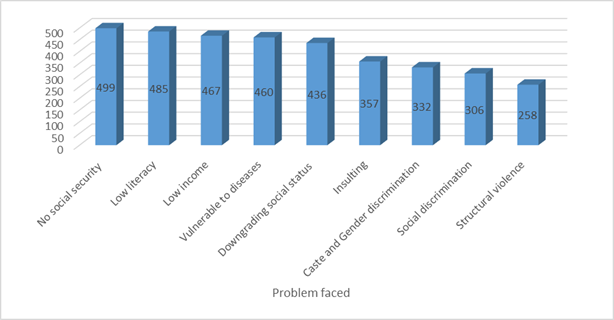
They
have no social security (6.24) in the society; They have low literacy (6.06);
Incurred low income mean score (5.83); they caused vulnerable diseases (mean
score- 5.75); the society don’t respect the scavenging work and the scavengers.
They downgrading in the society (5.45); people insulting the scavengers (4.46);
they discriminating the caste and gender (mean score-4.15); social
discrimination and structural violence mean score 3.82 and 3.23 respectively.
It is clear that social security is the main problem of the scavengers.
Table
-4: Weighted average Rank of the
Remedial measures of scavengers
|
Remedial
Measures |
Weighted Score |
Weighted Mean score |
Rank |
|
Enforcement of law |
504.00 |
6.3000 |
I |
|
Individual responsibility |
485.00 |
6.0625 |
II |
|
Fund management |
465.00 |
5.8125 |
III |
|
Training the locals |
402.00 |
5.0250 |
IV |
|
Education |
343.00 |
4.2875 |
V |
|
Rehabilitation and reintegration of manual scavengers |
320.00 |
4.0000 |
VI |
|
Creating awareness |
331.00 |
4.1375 |
VII |
|
Involvement of officials and community in initiatives |
265.00 |
3.3125 |
VIII |
Source: Derived
CHART-3 Weighted average Rank of the Remedial measures of scavengers
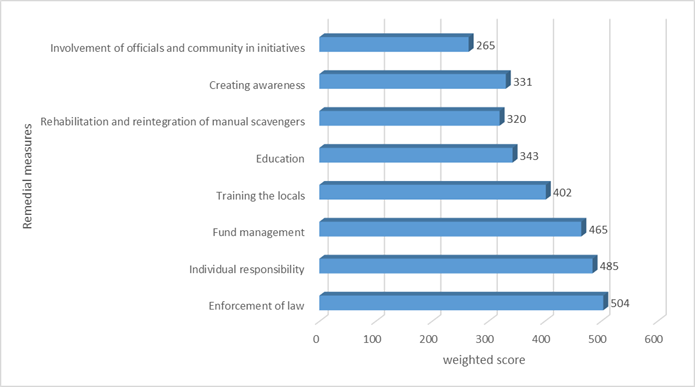
The government enforces
law for the economic status of the scavengers.
In fact, many benefits arrived through the enforcement of the law. But
extension of the law is more important for scavengers (6.30); Individual
responsibility is second rank of the problem of solution with the mean score
(6.06); fund management (5.81) is also more important to the scavengers;
trained the people of scavengers how to do easily, cleanly, time saving and
uninjured with safety equipment.
Fifth rank goes to Education with the mean
score (4.28), Sixth rank goes to Rehabilitation and reintegration of manual
scavengers (4.00), Creating awareness is seventh rank (4.13), Involvement of
officials and community in initiatives is eighth rank.
Table-5KMO and Bartlett's Testfor compulsion of performing other
task
|
Kaiser-Meyer-Olkin Measure of Sampling Adequacy. |
.768 |
|
|
Bartlett's Test of Sphericity |
Approx. Chi-Square |
414.219 |
|
Df |
120 |
|
|
Sig. |
.000 |
|
The Kaiser-Meyer-Olkin metric is a criterion for
determining sampling adequacy. Accepting values greater than 0.5 is recommended
by Kaiser (1974). Furthermore, numbers between 0.5 and 0.7 are mediocre, 0.7
and 0.8 are acceptable, 0.8 and 0.9 are outstanding, and values beyond 0.9 are
exceptional. The value for these data is 0.768, which is within the acceptable
range for using the data reduction approach.
The
Bartlett's test of sphericity assists a researcher in determining whether the
results of factor analysis are worth considering and whether the study activity
should be continued. The Bartlett's Test of Sphericity is significant at a
level of 0.001, indicating that there is a high level of correlation between
variables, making factor analysis appropriate.
Table-6 Nature of Task Performance
|
Nature of Task |
Components |
||
|
Death
Rituals |
Sanitation
|
Animal
related tasks |
|
|
Beating drums in funeral processions and other occasions |
.731 |
-.208 |
.088 |
|
Assisting in postmortem |
.721 |
.337 |
.042 |
|
Cremating unclaimed corpses |
.715 |
.182 |
.014 |
|
Taking the clothes of the deceased |
.678 |
.232 |
.008 |
|
Collecting food on special occasions |
.650 |
.245 |
-.021 |
|
Informing villagers about death rites |
.615 |
-.025 |
-.281 |
|
Castrating animals |
.548 |
.304 |
.454 |
|
Rearing pigs |
.436 |
.427 |
.098 |
|
Sweeping |
.051 |
.684 |
.242 |
|
Cleaning the surrounding of the pandal before wedding feast |
.262 |
.636 |
-.337 |
|
Cleaning drains |
-.117 |
.618 |
.157 |
|
Engaging in cleaning work prior to weddings |
.175 |
.578 |
-.252 |
|
Clearing up the leftovers |
.300 |
.569 |
-.085 |
|
Disposing animal faeces |
.192 |
.544 |
.526 |
|
Disposing animal carcasses |
.266 |
.083 |
-.658 |
|
Cleaning safety tanks |
.419 |
-.008 |
.540 |
|
% of Variance |
23.784 |
17.461 |
9.836 |
|
Cumulative % |
23.784 |
41.245 |
51.080 |
|
% to total |
47 |
34 |
19 |
|
Extraction Method: Principal Component Analysis. Rotation Method: Varimax
with Kaiser Normalization. |
|||
Respondent
opinion about economic status of scavengers based on sixteen variables are
explained in the table
Death Rituals: This factor consists of eight tasks related to death related jobs
such asBeating drums in funeral processions and other occasions (.731), Assisting
in postmortem (.721), Cremating unclaimed corpses (.715), Taking the clothes of
the deceased (.678), Collecting food on special occasions (.650), Informing
villagers about death rites (.615), Castrating animals (.548) and Rearing pigs
(.436). This factor has the variance of 23.784 consists of 47 percent out of
total.
Sanitation: This factor consists of six tasks related to death related jobs
such asSweeping (.684), Cleaning the surrounding of the pandal before wedding
feast (.636), Cleaning drains (.618), Engaging in cleaning work prior to
weddings (.578), Clearing up the leftovers (.569), and Disposing animal faeces (.544). This factor has the variance of 17.461consists
of 34 percent out of total.
Animal related: This factor
consists of two tasks related to death related jobs such asDisposing animal
carcasses (.658), and Cleaning safety tanks (.540). This factor has the
variance of 9.836 consists of 19 percent out of total.
CONCLUSION:
In
this regard, Dr. B.R. Ambedkar has stated that in India, a person does not have
to be a scavenger because of his vocation, but he is one regardless of whether
he scavenges or not. This raises worries and issues about what we are doing as
a country if we are oblivious to the condition of these manual scavengers. It
took many fatalities, as well as the efforts of social organisations and
non-governmental organisations (NGOs), to bring their predicament to light. So
many people have died as a result of manual scavenging, but few prosecutions
have been filed against the perpetrators. It is past time for the Indian
government to go beyond drafting laws and ensure that suitable equipment and
contemporary technology are used to clean septic tanks, drains, and sewages, so
that future generations are free of the humiliating duty of manual scavenging
and their dignity and rights are restored. It is concluded from the present
study that the majority of the scavengers are from the age between 31 to 45
because middle people can actively participate in their work. The inequality
was found high female scavengers than male scavengers (58%). The educational
background of most of the scavengers in this study were only elementary school
(87.6%), 91.7% were married, 63.8% are from Schedule Caste Arunthathiar (SCA)
community wise, 83.8% attended the health camp programs. Funerals, sanitation
performance and animal- related performance are the other performing tasks
besides scavenging. Cleaners face a major problem due to lack of social security.
The laws enforced should be carried on diligently. Many laws are enforced by
the government, but it does not reach the scavengers. Proper awareness can be
build to impart the laws on them to know their rights.
REFERENCES:
The Employment of Manual Scavengers
and Construction of Dry Latrines (Prohibition) Act, 1993. Ministry of Housing
and Urban Poverty Alleviation,
Govt. of India.
- Beck, H. and Darokar,
S.H.A.I.L.E.S.H.K.U.M.A.R., (2005). Socioeconomic status of scavengers
engaged in the practice of manual scavenging in Maharashtra. Indian
Journal of Social Work, 66(2), pp.223.
- Bhattacharjee,
S.S., (2014), Cleaning Human Waste:" manual Scavenging," Caste,
and Discrimination in India. Human Rights Watch.
- Clover,
D., (2000). Community arts as environmental adult education and activism.
Convergence, 33(4), pp.19.
- Del
pilarmoreno-sánchez, rocío; maldonado, jorgehiginio (2006). "Surviving
from garbage: the role of informal waste-pickers in a dynamic model of
solid-waste management in developing countries". Environment and Development Economics. 11 (3):371–391. doi:10.1017/S1355770X06002853. ISSN 1355-770X. JST OR 44379108. S2CID 154848705.
- De Serres G,
Levesque B, Higgins R, Major M, Laliberte D, Boulianne N, et al., (1995)
Need for vaccination of sewer workers against leptospirosis and hepatitis
A. Occup Environ Med. 1995;52:505–7.
- Dubey, S.Y. and Murphy, J.W., (2021).
Manual Scavenging in Mumbai: The Systems of Oppression. Humanity &
Society, 45(4), pp.533-555.
- DhirendraNewar (2020), International
Journal of Law Management & Humanities, International Journal
OfLawmanagement& Humanities 3(3).
- Hoshino, T., (2008). Transition
to municipal management: cleaning human waste in Tokyo in the modern era.
Nichibunken Japan Review, pp.189-202.
- Jeyalakshmi (2019),”Review of data on
survey and identification of manual scavengers”,Centre for law and policy
research.
- Kannadasan,
Akila (2012). "Remembering a great man". Features - Cinema. The Hindu.
- Kelly-Richards, S.H. and Banister, J.M.,(2017).
A state of suspended animation: Urban sanitation and water access in
Nogales, Sonora. Political Geography, 58, pp.104-113.
- Kothandaraman P, Vishwanathan V.
Sulabh international: A movement to liberate scavengers by implementing a
low-cost, safe sanitation system, (2007). Available from:
http://www.growinginclusivemarkets.org. [assessed on 2008 Oct 20]
- Kumar, K. and Shetty, D.R.,(2021).
SafaiKaramchari (Sanitary Workers)/Scavenger Community and Risk of
Coronavirus (COVID-19) Pandemic in India. Contemporary Voice of Dalit,
p.2455328X211044570.
- Lalwani, Vijayta.(2021) "How do other countries clean their sewers and
is there something India can learn from them?"
- PRIA
(2019): Lived Realities
of Women Sanitation Workers in India: Insights from a Participatory
Research Conducted in Three Cities of India. Participatory Research in Asia, New
Delhi, India
- Rajneesh Kumar Gautam,
Islamuddin, Nandkishor, Mohammad Usama et al, (2017), Manual Scavenging in
India, IJNRD, 2(4).
- Rankokwane, Batsumi;
Gwebu, Thando D.(2006). "Characteristics,
threats and opportunities of landfill scavenging: The case of
Gaborone-Botswana". GeoJournal. 65 (3):
151–163. doi:10.1007/s10708-005-3122-3. ISSN 0343-2521. JSTOR 41148032. S2CID 153618319.
- Ray, I., Prasad, CS S. (2018). Where there are
no Sewers - Photoessays on Sanitation Work in Urban India. Sustainable Sanitation Alliance
(SuSanA) secretariat at GIZ, Eschborn, Germany
- "SafaiKaramchariAndolanAndOrsvs Union Of India
And Ors" (2014). Supreme
Court of India.
- Saravanakumar, S., (20190.
Manual Scavenging in India: Issues & Challenges. International Journal
of Trend in Scientific Research and Development, 3(5), pp.800-803.
- "Sanitation Worker Project Animation
(video)" (2018). Dalberg Global Development Advisors. 3 September 2018.
- Shahid, M., (2015). Manual
scavenging: Issues of caste, culture and violence. Social Change, 45(2),
pp.242-255.
- Shankar, S. and Swaroop, K.,
(2021). Manual Scavenging in India: The Banality of an Everyday Crime.
CASTE/A Global Journal on Social Exclusion, 2(1), pp.67-76.
- Singh,
R.K., (2009). Manual scavenging as social exclusion: A case study.
Economic and Political Weekly, pp.521-523.
- Zaidi A., (2006) India's shame.
Frontline 9-22. [Google Scholar].