A
Study to Comprehend Quality Time Management of Working Women for the Family
Dr. Goldie Zaki
Asst. Professor, St. Paul Institute
of Professional Studies Indore
zaki.goldie@gmail.com
ABSTRACT
The term quality time has been
complimented when it is talked about work-life balance. The problem of spending
quality time applies to both the parents, but it becomes more important when it
comes to working women. This is for the reason that woman is the heart of the
family and has to entail the entire family coupled with household work. The
demands and pressures of work makes it difficult for women to spend quality
time with their family. This study with the sample size of 120 working women
was conducted to comprehend whether the women are able give quality time to
their family, to find out the difficulties and challenges faced by them and to
explore steps taken by her to fulfill family responsibility. The data was
collected from respondent through well designed questionnaire. After analyzing,
results show that the women have become smart and due to awareness about the
role as a parent, they are able to give quality time to their family.
Key words: Quality
Time; Working Women; Challenges; Time Management
INTRODUCTION
With the growing complexities of life, rise in
inflation, desire for better standard of living and similar reasons, the women
have now come to the work force area. Almost all the sectors of the economy
have women in their work force. In ancient times, as far as our country India
is concerned, the women used to stay at home taking care of household works and
family. But in the contemporary world, the women have become educated and also
have an urge to financially support their families. Thus, being working women
has become a common phenomenon. Nevertheless, as the mother in the family, a
woman has to pay attention towards the family, more importantly, the children.
Due to the working hours and work pressure, women find it difficult to spend
quality time with the family.
RATIONALE OF STUDY
Owing to the fact that women has to play diverse
role, each being important, there is a definite possibility that they find it
difficult to manage their time. The ever growing demands of the job and call
for increased employee dedication has posed problems and challenges for the
working women. The problem is mainly at the family front because the women find
it tough to give quality time to the family. Giving quality time to family is
also very crucial part of a women’s life that cannot be neglected.
Hence, this study has been done with working women
being the variable of study, in order to understand the problems faced in
fulfilling family responsibilities.
OBJECTIVES OF STUDY
Ø To
discuss main challenges faced by working women at home and at workplace.
Ø To
throw light on steps taken by her to fulfill family responsibility.
HYPOTHESIS OF STUDY
Ø H0:Working
women manage quality time for family.
Ø H1:Working
Women are not able to manage quality time for family.
RESEARCH
METHODOLOGY
Ø Researher
took 120 working women as sample size
and took response from them with the help of questionnaire.
REVIEW OF LITERATURE
Lal Kumar Singh (2019) in a study
Impact of Working Mothers on their Children's Development attempted to identify and analyse the positive and
negative effects of working mother on children’s development and learning.
Studies suggest that working mothers create self-confidence, social awareness
and sense of commitment and struggle among children with a lot of monetary
benefits. Working mother with sense of
achievement and fulfilment can serve as a good role model for her children and
also inspired them to peruse their dreams and ambition. But if working mother
bring her frustration home, children tend to develop a negative attitude and
also fails to provide a safe emotional outlet.
This interrupts the cognitive, affective and psychomotor development of
children. The quality of parenting and managing skill among working mother
reduces the negative effects.
Iga Magda and Roma Keister (2018) conducted a study titled ‘Working Time Flexibility
and Parental ‘Quality Time’ Spent with Children’ with a aim to analyze the
effect of working time flexibility on parental time devoted to children on a
large panel survey of Polish households carried out in 2013 and 2014. They studied
how various dimensions of working time flexibility can affect the amount of
quality time parents spend with their children. The result shows that
employment status of parents and their working time arrangements are not
statistically significant for the amount of parental ‘quality time’ devote with
their children. Parents being human and cultural capital and their values that
are primary factors that decide the amount of parental time investments.
Katie
R. Genadeka,b and Rachelle Hill (2017)studied overlap between
work and family by investigating the relationship between attributes of work
schedules for parents and the amount of time they spend with their children.
Nationally representative time diary data from the ATUS was used to calculate
the quantum of time parents spend with children on a casual day, and this data
was combined with the CPS Work Schedules Supplement which offers information on
the respondent’s usual work schedule, such as having a flexible schedule,
variable start and stop times, working from home or a day schedule. The results
indicate that though some work schedule attributes have little effect on the
amount of time parents spend with children, some aspects of the timing of work
are related to the total time parents spend with their children. The attributes
of work schedules are also found to be related with the amount of time spent in
certain activities with children.
JayitaPoduval*
and Murali Poduval (2009)discussed that motherhood calls upon a woman the
responsibility of bringing up a child. This course also changes the way in
which she is seen in society and at her workplace. It can require her to take
more than obtainable leave options, and job security can be at danger.
Important social and personal alterations are necessary to manage such a
situation. A working mother, especially one who has the good affluence to be
able to balance her home and work, enjoys the motivation that a job or career
provides. She grows the ability of rising a useful member of society and
together gains financial independence. Along with parenthood, work enhances the
completeness of being a woman.
CHALLENGES FACED BY
WORKING WOMEN
Quality time means spending time
together that develops closeness, understanding and trust between parents and
their children. The interaction helps them to know each other better and
connect more closely. It is found that children who live quality time with
their parents are less probable to have issues related to behavior within the
family and also at school. The mother, children and family desire to spend
quality time but it is not easy. The working women are posed to many challenges
and difficulties at home and workplace that are as follows:-
- Scarcity of time
A crucial
challenge that women face is the insufficiency of time. The time has to be
managed between, home, office, children and self. It is prettyhard to reserve
time for every such requirementin the most favorable way. If the mother is too
busy most of the days, it becomes hard for the child to understand why the
motheris not available for them.
- Failing in imparting values to
children
Studies indicate that due to lack
of moral teachings, children tend to get into unwanted activities and
demonstrate unaccepted behavior patterns. Current life style has opened ways
for even kids to get acquainted with computers, television, internet and explore
both good and bad realities of life and many often they follow the so called
bad or unaccepted paths of life.
- Imbalanced life style
Imbalanced life
is an added challenge the modern women face. Office, work, kids, personal
requirements; all are important and so nothing can be neglected. Matchingup all
of these requirements is a tedious task, and consequently, many parents become
very imbalanced in life.
- Emotive
dissolution
Absence of emotional bondage is a
challenge many working women face in life. They tend to lose time and mind to
spend with family and develop emotional bondage with them. Being aware of the
emotions of each other is important to grow affectionately. When the emotional
bond between women and family get broken, there is a drift in the family and
children start to live their own world.
- Lack of
concentration
Due to imbalance
in work-life and emotional pressure, there arises the problem of concentration.
At time, the women at home is engaged thinking about the work pressure thus,
unable to concentrate on family and sometime, she is engrossed in family
problem at workplace. This creates the problem of concentration.
STEPS TO TAKEN BY WORKING WOMEN TO BALANCE
WORK LIFE AND FAMILY LIFE
- Properly teach the family specially the children the ways of being
self-sufficient when the parents are away.
- Learn to balance life by preplanning the ways of performing the
required duties. This would help in facing the challenges in life and
becoming effective parents.
- Find out the possible reasons for imbalance in life and be prepared
to respond to them in the best possible and positive manner.
- The women need to prioritize her time. This would help in effective
time management.
- Concentrating on one thing at a time may also help in the direction
of increasing work-life balance.
- Instead of limiting the problems to herself, women should share it
in the family so that the members develop empathy for her.
- The women should learn to assign work to family members and also the
colleagues and should not take all responsibilities on her.
- The women should necessarily build the habit of spending quality
time with family even when it is too difficult. Doing this even if it
forcefully will help develop family bonding and help the family to find
fun time.
- Last but not the least, the women should try to find time for
herself. A time that is only hers and not shared.
HYPOTHESIS TESTING
v H0:
Working women manage quality time for family.
The
items in the questionnaire included working women’s time issues and their
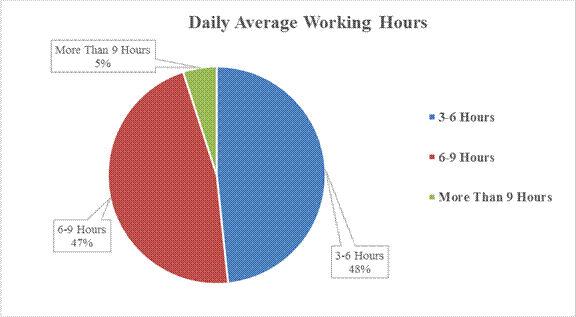
effect on their family. Following chart shows that on and average time spend by
working women for their work.
Figure 1: Average Time Spend By
Working Women For Their Work
Table
1 : ANOVA for Quality Time Spent with Family
|
Q6, Q9 & Q10 ANOVA: Single Factor |
|||||||
|
SUMMARY |
|||||||
|
Groups |
Count |
Sum |
Average |
Variance |
|||
|
Daily Working Hours |
60 |
154 |
2.566667 |
0.351412 |
|||
|
Time spent with family |
60 |
172 |
2.866667 |
1.20226 |
|||
|
Satisfaction with Family Time |
60 |
93 |
1.55 |
0.251695 |
|||
|
ANOVA |
|||||||
|
Source of Variation |
SS |
df |
MS |
F |
P-value |
F crit |
|
|
Between Groups |
57.14444 |
2 |
28.57222 |
47.4788 |
3.11E-17 |
3.047012 |
|
|
Within Groups |
106.5167 |
177 |
0.601789 |
||||
|
Total |
163.6611 |
179 |
|
|
|
|
|
Findings: Researcher took 120 samples from working women
through questionnaire. Above ANOVA is showing the value of P 3.11, it is higher
than 0.05. It shows that our Null hypothesis is accepted. Women are getting
time to spend with their family accepting that they can manage their work life
and home life in balanced way.
Following
chart shows the quality time which is spent by working women with their family.
Figure 1: Daily Time Spent with
Family
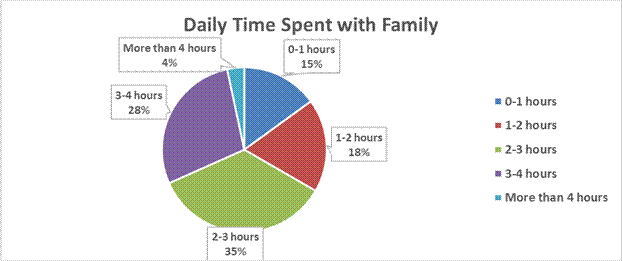
Table 2: ANOVA for QC and QE
|
Anova: Single Factor Q6, Q11& Q15 |
||||||||||||
|
SUMMARY |
||||||||||||
|
Groups |
Count |
Sum |
Average |
Variance |
||||||||
|
Daily Working Hours |
60 |
154 |
2.566667 |
0.351412 |
||||||||
|
Time Spent with family |
60 |
172 |
2.866667 |
1.20226 |
||||||||
|
Family's expressive behavior towards women |
60 |
83 |
1.383333 |
0.240395 |
||||||||
|
Family Satisfaction |
60 |
97 |
1.616667 |
0.240395 |
||||||||
|
ANOVA |
||||||||||||
|
Source of
Variation |
SS |
Df |
MS |
F |
P-value |
F crit |
||||||
|
Between Groups |
93.15 |
3 |
31.05 |
61.04804 |
3E-29 |
2.642851 |
||||||
|
Within Groups |
120.0333 |
236 |
0.508616 |
|||||||||
|
Total |
213.1833 |
239 |
|
|
|
|
||||||
|
SUMMARY |
||||||||||||
|
Groups |
Count |
Sum |
Average |
Variance |
||||||||
|
Daily Working Hours |
60 |
154 |
2.566667 |
0.351412 |
||||||||
|
Time Spent with family |
60 |
172 |
2.866667 |
1.20226 |
||||||||
|
Child's performance in creative
work |
60 |
92 |
1.533333 |
0.253107 |
||||||||
|
ANOVA |
||||||||||||
|
Source of
Variation |
SS |
Df |
MS |
F |
P-value |
F crit |
||||||
|
Between Groups |
58.71111 |
2 |
29.35556 |
48.74234 |
1.37E-17 |
3.047012 |
||||||
|
Within Groups |
106.6 |
177 |
0.60226 |
|||||||||
|
Total |
165.3111 |
179 |
|
|
|
|
||||||
Findings: -
Above ANOVA is applied on QC and QE, the P value is 1.377 which is higher than
0.05. It is proved that Null hypothesis is accepted and alternative hypothesis
is rejected. Working women do not have quality time to give their kids, is
rejected.
CONCLUSION
In the sample survey conducted on
120 women, it has been found that the women are able to manage quality time
with their family and children. With the help of information technology,
awareness, internet facility, good transportation facility etc. it has been
seen that women are able to save time and utilize that time as quality time.
Though work-life balance has always been a problem, but the study done is
optimistic in nature indicating a positive result of better quality time
management.
REFERENCES
Books
and Journals
1.
Singh, L. (2019).
Impact of Working Mothers on their Children's Development. Innovation The Research Concept, 3(3), 18-21.
- Jayita
Poduval, J. & Poduval, M. (2009). Working Mothers: How Much
Working, How Much Mothers, And Where Is The Womanhood? Mens Sana
Monographs, 7(1), 63–79. 7(1):
63–79. doi: 10.4103/0973-1229.41799
- Magda, I
& Keister, R. (2018). Working Time Flexibility and Parental ‘Quality
Time’ Spent with Children. IZA
Institute of labour Economics, IZA DP No. 11507, 1-39.
Websites and links:
- https://www.prokerala.com/kids/parenting/parenting-challenges.htm
- https://babygooroo.com/articles/challenges-faced-by-working-moms
- https://www.salary.com/articles/14-steps-to-achieving-work-life-balance/
- https://www.carizon.ca/looking-better-manage-work-family-life-2014-try-12-tips/
Appendix:
Questionnaire
This
survey for societal research useful for academic purposes only. The identity of
the respondent will be disguised. So, please respond with the utmost honesty so
that results can be useful for the desired purpose.
Q1. What is your current relationship status?
(a) Married (b)
Single (c)Widowed (d) Divorced
Q2. Do you have children?
(a)Yes (b)
No
Ifyes,thenpleasemarkinbelowbox(wherethecolumnrepresentsno.ofchildrenand
row gives the age group of yourchild)
(a)0-5 (b)
5-8 (c) 8-12 (d) 12-18 (e) Over 18
Q3. What
is your educational qualification?
(a)Below SSC (b)
SSC passed (c) HSC or Junior
CollegePassed
(d) Undergraduate (e)Postgraduate (f) Doctorate
(g)CertifiedProfessional (h)
Others
Q4. What
is your current occupational status?
(a) Homemaker(housewife) (c) Self-employed business
(b) Service(employee) (d) Self-employed
professional.
Q5.
In which sector are youemployed?
(a)Medical (b)Finance/Banking(c)
Information Technology(IT)
(d)Educational (e)Business (f)Law
(g) Creative field (photography, filmmaking,artist) (h) Governmentjob
Q6. What
are your working hours daily (on average)?
(a)0-3hours (b)3-6hours (c)6-9hours (d) More than 9hours
Q7. How
many days a week you work?
(a) 4 daysorless (b)5days (c)6days (d) More than 6days
Q8. How
often you have to work on weekends?
(a)Always (b)
Never
Q9. How
many hours on Might Be you spent time with your children or family?
(a)0-1hour (b)1-2hour (c)2-3hour (d) 3-4hour (e)More
than 4hours
Q10. Do you think you spend enough time with your child? If yes then
how many hours on an average?
(a)Yes, (b)No
Q11. Do
your familyis able to express themselves in front of you?
(a)Yes (b)No
Q12. Does
he perform well in academics?
(a)Yes (b)No
Q13. Does
he perform well in sports?
(a)Yes (b)No
Q14. Does
he perform well in art or creative work?
(a)Yes (b)No
Q15. Do
your family is satisfied with your balance steps towards your work and home
life.
(a)Yes (b)No
********